victoria had $200 in her account at the end of one year. at the first of each subsequent year she deposits…
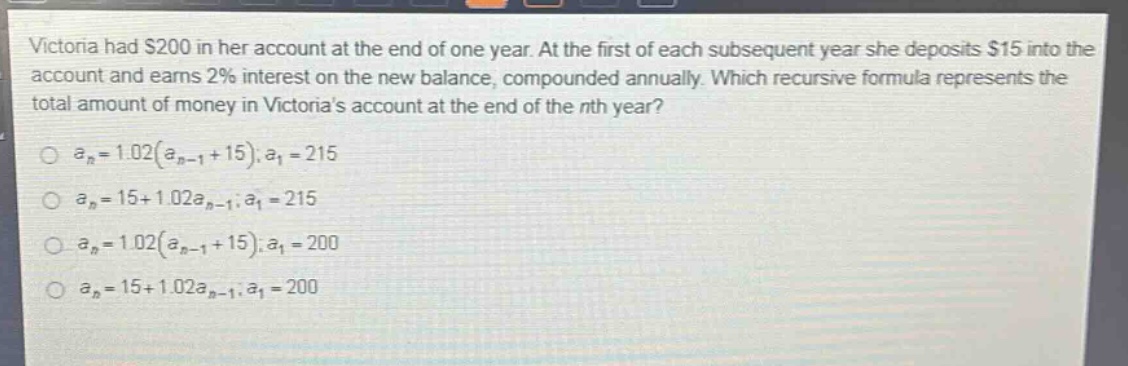
victoria had $200 in her account at the end of one year. at the first of each subsequent year she deposits $15 into the account and earns 2% interest on the new balance, compounded annually. which recursive formula represents the total amount of money in victorias account at the end of the nth year?\n$a_n = 1.02(a_{n - 1}+15);a_1 = 215$\n$a_n = 15 + 1.02a_{n - 1};a_1 = 215$\n$a_n = 1.02(a_{n - 1}+15);a_1 = 200$\n$a_n = 15 + 1.02a_{n - 1};a_1 = 200$
Answer
Explanation:
Step1: Analyze the first - year amount
At the end of the first year, Victoria has $a_1 = 200+15=215$ dollars. She starts with $200$ and deposits $15$ at the start of the second - year.
Step2: Analyze the recursive relationship
The amount in the account at the end of the $n$th year ($a_n$) is calculated as follows: First, she deposits $15$ at the start of the $n$th year into the account with balance $a_{n - 1}$ from the previous year. Then, she earns 2% interest on the new balance ($a_{n-1}+15$). So, $a_n=1.02(a_{n - 1}+15)$.
Answer:
A. $a_n = 1.02(a_{n - 1}+15);a_1 = 215$