if you deposit $1000 in a savings account with an interest rate of $r$ compounded annually, then the balance…
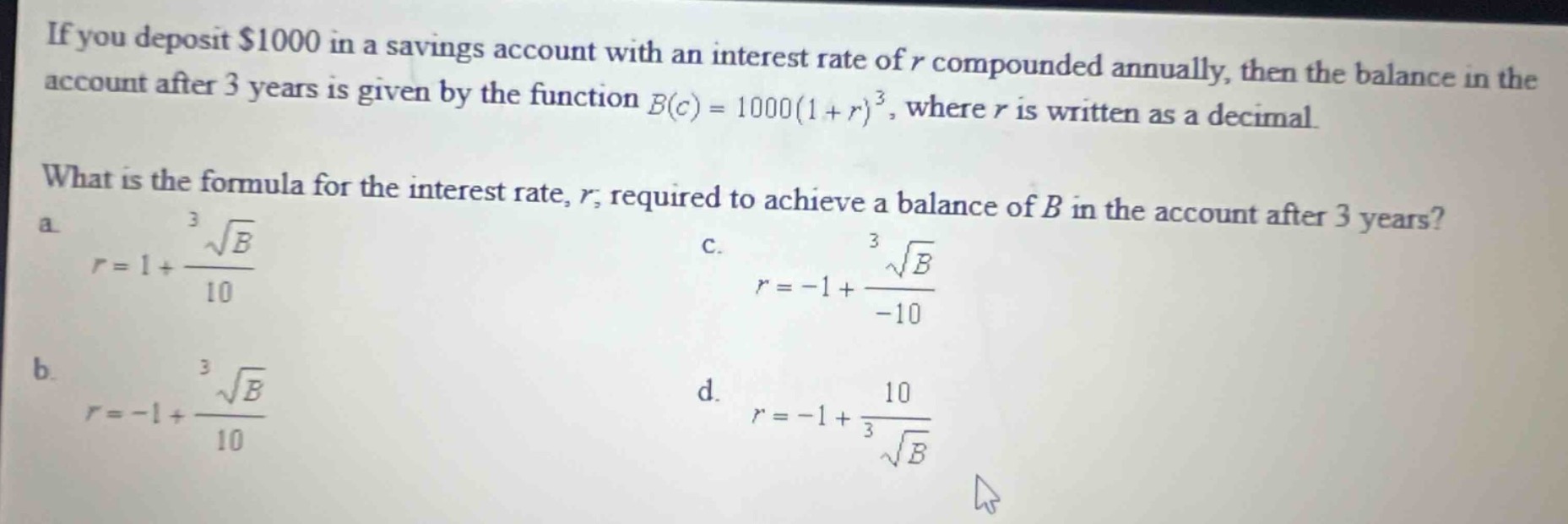
if you deposit $1000 in a savings account with an interest rate of $r$ compounded annually, then the balance in the account after 3 years is given by the function $b(c)=1000(1 + r)^{3}$, where $r$ is written as a decimal. what is the formula for the interest rate, $r$, required to achieve a balance of $b$ in the account after 3 years? a. $r = 1+\frac{sqrt3{b}}{10}$ c. $r=-1+\frac{sqrt3{b}}{- 10}$ b. $r=-1+\frac{sqrt3{b}}{10}$ d. $r=-1+\frac{10}{sqrt3{b}}$
Answer
Explanation:
Step1: Start with given formula
$B = 1000(1 + r)^3$
Step2: Isolate $(1 + r)^3$
$\frac{B}{1000}=(1 + r)^3$
Step3: Take cube - root of both sides
$\sqrt[3]{\frac{B}{1000}}=1 + r$ Since $\sqrt[3]{\frac{B}{1000}}=\frac{\sqrt[3]{B}}{10}$, we have $\frac{\sqrt[3]{B}}{10}=1 + r$
Step4: Solve for $r$
$r=- 1+\frac{\sqrt[3]{B}}{10}$
Answer:
B. $r=-1+\frac{\sqrt[3]{B}}{10}$