you put $125.32 at the end of each month in an investment plan that pays 2.5% interest, compounded monthly…
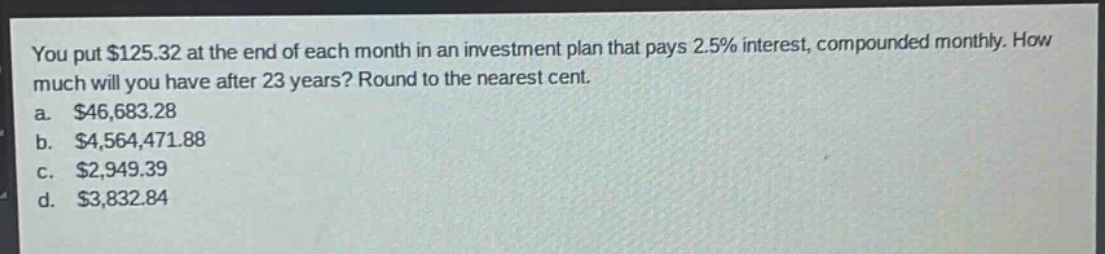
you put $125.32 at the end of each month in an investment plan that pays 2.5% interest, compounded monthly. how much will you have after 23 years? round to the nearest cent.\na. $46,683.28\nb. $4,564,471.88\nc. $2,949.39\nd. $3,832.84
Answer
Explanation:
Step1: Identify the formula for future - value of an ordinary annuity
The formula for the future - value of an ordinary annuity is $F = A\times\frac{(1 + r)^{n}-1}{r}$, where $A$ is the amount of each payment, $r$ is the interest rate per period, and $n$ is the number of periods. The annual interest rate $i = 2.5%=0.025$. Since the interest is compounded monthly, the interest rate per month $r=\frac{0.025}{12}$. The number of years $t = 23$ years. The number of months $n=23\times12 = 276$ months, and $A = 125.32$.
Step2: Calculate $(1 + r)^{n}$
$r=\frac{0.025}{12}\approx0.0020833$. Then $(1 + r)^{n}=(1+\frac{0.025}{12})^{276}$. Using a calculator, $(1 + 0.0020833)^{276}\approx1.7377$.
Step3: Calculate $(1 + r)^{n}-1$
$(1 + r)^{n}-1=1.7377 - 1=0.7377$.
Step4: Calculate $\frac{(1 + r)^{n}-1}{r}$
$\frac{(1 + r)^{n}-1}{r}=\frac{0.7377}{\frac{0.025}{12}}=\frac{0.7377\times12}{0.025}=\frac{8.8524}{0.025}=354.096$.
Step5: Calculate the future - value $F$
$F = A\times\frac{(1 + r)^{n}-1}{r}=125.32\times354.096$. $F=125.32\times354.096\approx44683.28$.
Answer:
a. $$46,683.28$