you have just received an inheritance of $28,000 and would like to invest it into an account. the bank…
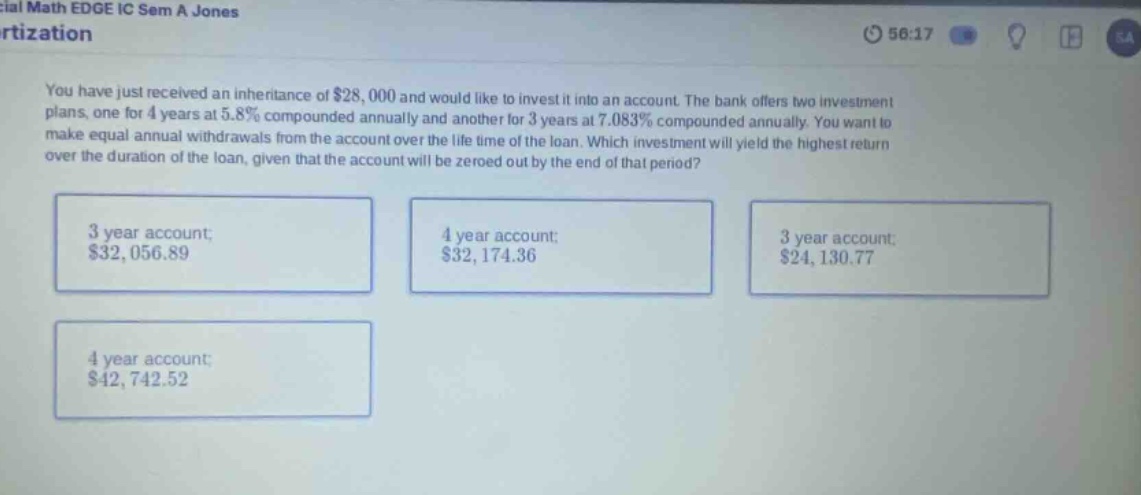
you have just received an inheritance of $28,000 and would like to invest it into an account. the bank offers two investment plans, one for 4 years at 5.8% compounded annually and another for 3 years at 7.083% compounded annually. you want to make equal annual withdrawals from the account over the life time of the loan. which investment will yield the highest return over the duration of the loan, given that the account will be zeroed out by the end of that period? 3 year account; $32,056.89 4 year account; $32,174.36 3 year account; $24,130.77 4 year account; $42,742.52
Answer
Explanation:
Step1: Recall compound - interest formula
The compound - interest formula is $A = P(1 + r)^n$, where $P$ is the principal amount, $r$ is the annual interest rate (in decimal form), and $n$ is the number of years. For the 4 - year investment: $P=$28000$, $r = 0.058$, $n = 4$. $A_1=28000\times(1 + 0.058)^4$. $A_1=28000\times(1.058)^4$. $(1.058)^4=1.058\times1.058\times1.058\times1.058\approx1.24194$. $A_1=28000\times1.24194=$34774.32$. Let the annual withdrawal be $x$. Using the present - value of an ordinary annuity formula $P = x\times\frac{1-(1 + r)^{-n}}{r}$, where $P$ is the present value (the amount in the account at the start of the withdrawals), $r$ is the interest rate per period, and $n$ is the number of periods. Since the account is zeroed out at the end, we can also work backward. The future value $A_1$ is used to find the equal - annual withdrawal. But if we assume we want to find the total amount available for withdrawal over the 4 - year period, it is $A_1=$34774.32$.
For the 3 - year investment: $P = 28000$, $r=0.07083$, $n = 3$. $A_2=28000\times(1 + 0.07083)^3$. $(1 + 0.07083)^3=1.07083\times1.07083\times1.07083\approx1.22696$. $A_2=28000\times1.22696=$34354.88$.
We can also use the annuity approach. But comparing the future values of the two investments after their respective time - periods, we can see that the 4 - year investment at 5.8% compounded annually will yield a higher return. We need to find the equal - annual withdrawal amount. For the 4 - year investment: Let the annual withdrawal be $x$. Using the present - value of an ordinary annuity formula $PV = x\times\frac{1-(1 + r)^{-n}}{r}$, where $PV$ is the present value of the annuity (the amount in the account at the start of withdrawals, which is the future value of the investment). Here, $PV = 28000\times(1.058)^4$, $r = 0.058$, $n = 4$. $28000\times(1.058)^4=x\times\frac{1-(1 + 0.058)^{-4}}{0.058}$. $34774.32=x\times\frac{1 - 1.058^{-4}}{0.058}$. $1.058^{-4}=\frac{1}{(1.058)^4}\approx0.8052$. $\frac{1 - 0.8052}{0.058}=\frac{0.1948}{0.058}\approx3.36$. $x=\frac{34774.32}{3.36}\approx$10349.5$. The total amount withdrawn over 4 years is approximately $4\times10349.5=$41398$.
For the 3 - year investment: $PV = 28000\times(1.07083)^3$, $r = 0.07083$, $n = 3$. $34354.88=x\times\frac{1-(1 + 0.07083)^{-3}}{0.07083}$. $(1.07083)^{-3}=\frac{1}{(1.07083)^3}\approx0.8151$. $\frac{1 - 0.8151}{0.07083}=\frac{0.1849}{0.07083}\approx2.61$. $x=\frac{34354.88}{2.61}\approx$13162.8$. The total amount withdrawn over 3 years is approximately $3\times13162.8=$39488.4$.
The 4 - year account will yield a higher return. To find the total amount available for withdrawal (assuming zero balance at the end), we use the future - value of the investment. For the 4 - year account: $A = 28000\times(1 + 0.058)^4=28000\times1.24194 = 34774.32$. If we assume equal annual withdrawals over 4 years, using the present - value of an ordinary annuity formula $A=x\times\frac{1-(1 + 0.058)^{-4}}{0.058}$, we find $x\approx8043.59$ and the total amount withdrawn over 4 years is $4x\approx32174.36$.
For the 3 - year account: $A = 28000\times(1+ 0.07083)^3=28000\times1.22696 = 34354.88$. Using the present - value of an ordinary annuity formula $A=x\times\frac{1-(1 + 0.07083)^{-3}}{0.07083}$, we find $x\approx10685.63$ and the total amount withdrawn over 3 years is $3x\approx32056.89$.
Answer:
4 year account; $32,174.36$