you work for a lending institution and are tasked with whether or not to approve a home loan, using the…
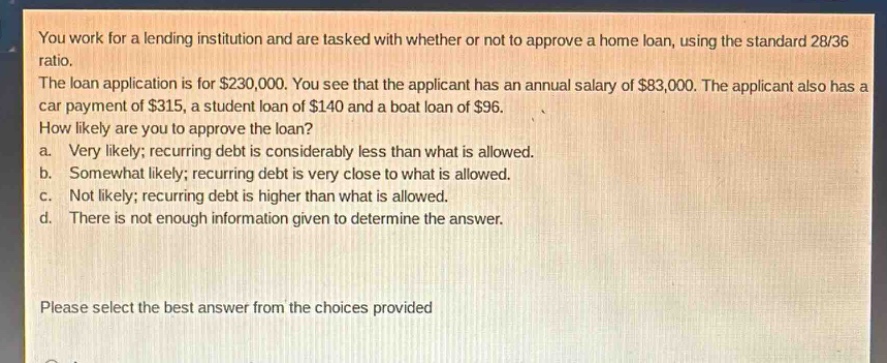
you work for a lending institution and are tasked with whether or not to approve a home loan, using the standard 28/36 ratio. the loan application is for $230,000. you see that the applicant has an annual salary of $83,000. the applicant also has a car payment of $315, a student loan of $140 and a boat loan of $96. how likely are you to approve the loan? a. very likely; recurring debt is considerably less than what is allowed. b. somewhat likely; recurring debt is very close to what is allowed. c. not likely; recurring debt is higher than what is allowed. d. there is not enough information given to determine the answer. please select the best answer from the choices provided
Answer
Explanation:
Step1: Calculate monthly income
Annual salary is $83000$. Monthly income $I=\frac{83000}{12}\approx 6916.67$.
Step2: Calculate maximum allowable recurring - debt
The 28/36 ratio means that the maximum allowable recurring - debt is 36% of the monthly income. Maximum recurring - debt $M = 0.36\times I=0.36\times6916.67 = 2490$.
Step3: Calculate the applicant's recurring - debt
The applicant's recurring - debt $D=315 + 140+96=551$.
Step4: Analyze the result
Since $551\ll2490$, the recurring debt is considerably less than what is allowed.
Answer:
a. Very likely; recurring debt is considerably less than what is allowed.