directions: answer the questions based on the passage, \what came first: the chicken or the egg?\\n\n1. in…
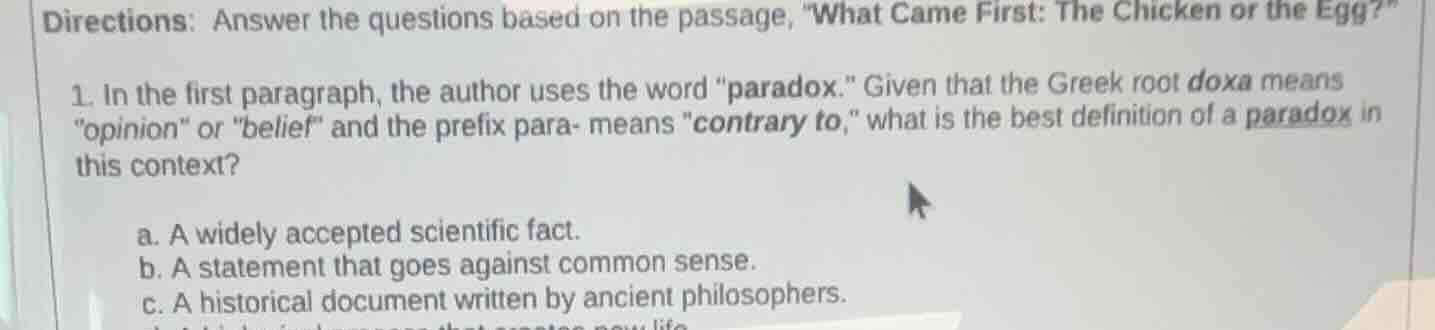
directions: answer the questions based on the passage, \what came first: the chicken or the egg?\\n\n1. in the first paragraph, the author uses the word \paradox.\ given that the greek root doxa means \opinion\ or \belief\ and the prefix para- means \contrary to,\ what is the best definition of a paradox in this context?\n\na. a widely accepted scientific fact.\nb. a statement that goes against common sense.\nc. a historical document written by ancient philosophers.\nd. a biological process that creates new life.
Answer
Brief Explanations:
The word "paradox" is derived from the Greek prefix para- (contrary to) and the root doxa (opinion or belief). Etymologically, it refers to something that contradicts received opinion or common belief. In the context of the "chicken or the egg" dilemma, it describes a situation or statement that seems self-contradictory or logically impossible based on standard reasoning, yet may be true. Among the choices, option B directly reflects the meaning of "contrary to common belief or sense."
Answer:
b. A statement that goes against common sense.