what is one difference in the way sensory details are used in \harlem\ and \the weary blues\?\n\harlem\ uses…
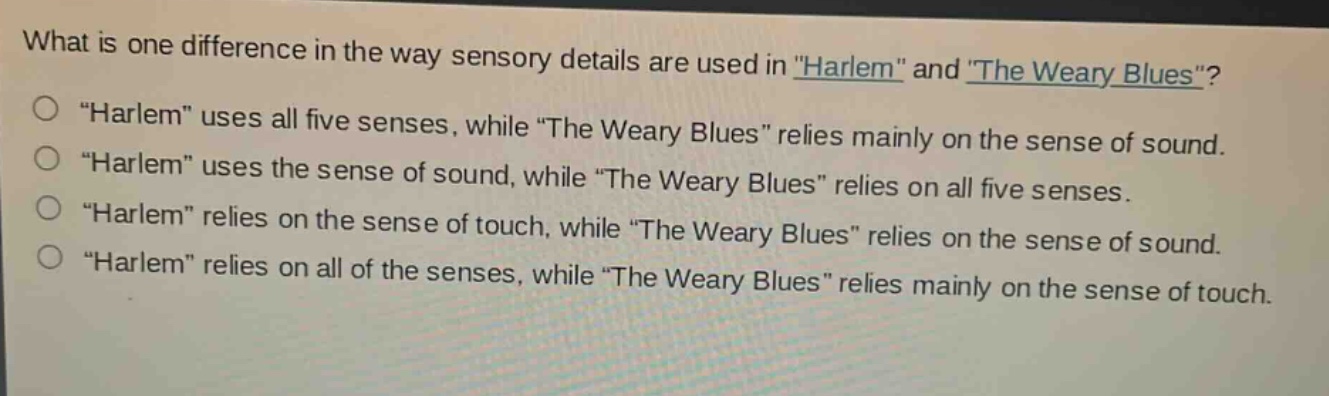
what is one difference in the way sensory details are used in \harlem\ and \the weary blues\?\n\harlem\ uses all five senses, while \the weary blues\ relies mainly on the sense of sound.\n\harlem\ uses the sense of sound, while \the weary blues\ relies on all five senses.\n\harlem\ relies on the sense of touch, while \the weary blues\ relies on the sense of sound.\n\harlem\ relies on all of the senses, while \the weary blues\ relies mainly on the sense of touch.
Answer
Brief Explanations:
"Harlem" by Langston Hughes uses a variety of sensory details including all five senses to explore the deferred dreams. "The Weary Blues" focuses more on the auditory - the sound of the blues being played. It creates a strong sense of sound through descriptions of the musician's playing and singing.
Answer:
A. “Harlem” uses all five senses, while “The Weary Blues” relies mainly on the sense of sound.