read the excerpt from \hokusais the great wave.\ but there are other ways of reading hokusais great wave…
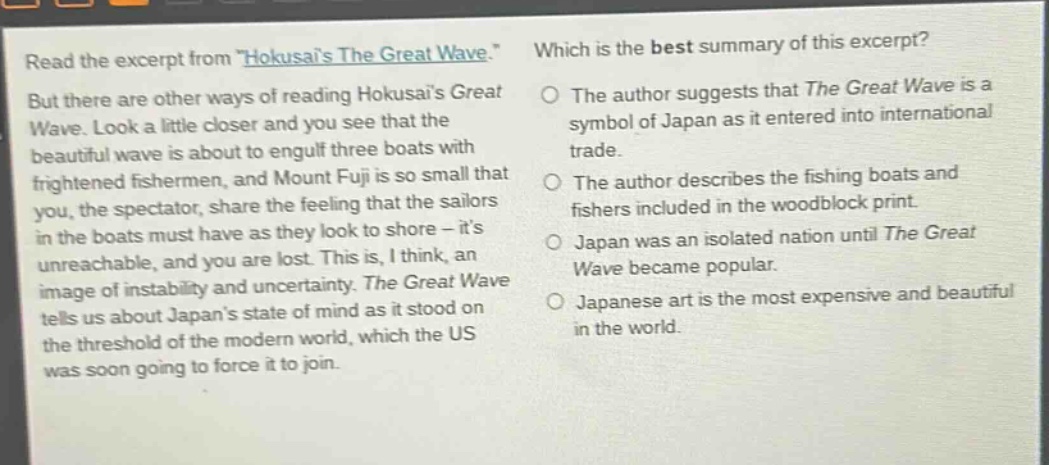
read the excerpt from \hokusais the great wave.\ but there are other ways of reading hokusais great wave. look a little closer and you see that the beautiful wave is about to engulf three boats with frightened fishermen, and mount fuji is so small that you, the spectator, share the feeling that the sailors in the boats must have as they look to shore - its unreachable, and you are lost. this is, i think, an image of instability and uncertainty. the great wave tells us about japans state of mind as it stood on the threshold of the modern world, which the us was soon going to force it to join. which is the best summary of this excerpt? the author suggests that the great wave is a symbol of japan as it entered into international trade. the author describes the fishing boats and fishers included in the woodblock print. japan was an isolated nation until the great wave became popular. japanese art is the most expensive and beautiful in the world.
Answer
Brief Explanations:
The excerpt discusses how Hokusai's The Great Wave represents Japan's state - of - mind as it was on the verge of entering the modern world and international trade. It emphasizes the symbolism of instability and uncertainty. The first option captures this essence as it mentions the wave as a symbol of Japan as it entered international trade. The second option only focuses on the boats and fishers, missing the larger symbolic meaning. The third option is about Japan's isolation and the popularity of the wave, not the main idea of the wave as a symbol of Japan's state of mind. The fourth option is about Japanese art in general, not related to the excerpt's focus on The Great Wave.
Answer:
The author suggests that The Great Wave is a symbol of Japan as it entered into international trade.