read these lines from shakespeares \sonnet 100.\ where art thou, muse, that thou forgetst so long to speak…
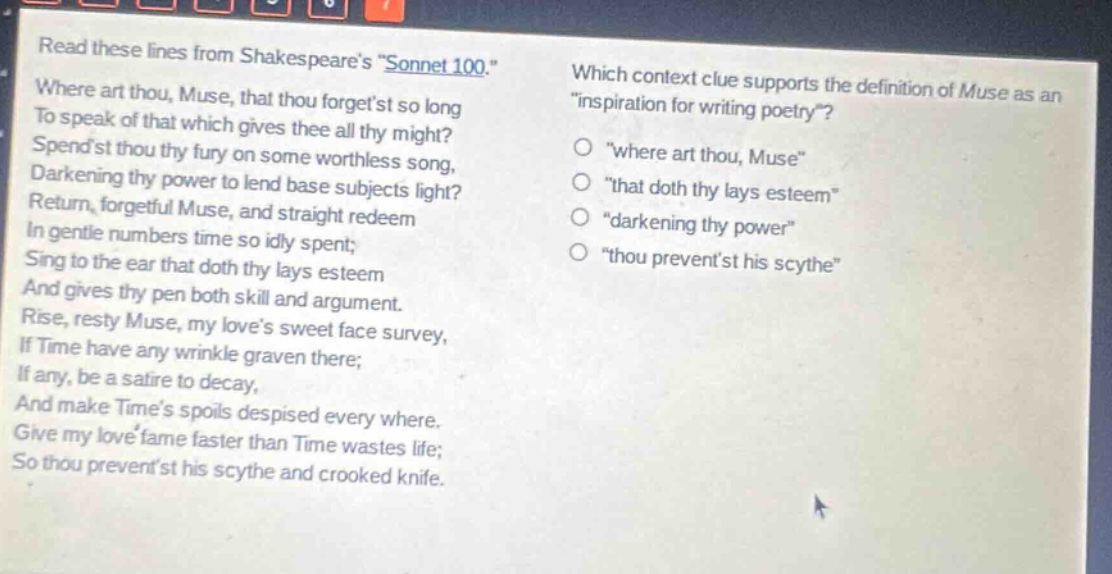
read these lines from shakespeares \sonnet 100.\ where art thou, muse, that thou forgetst so long to speak of that which gives thee all thy might? spendst thou thy fury on some worthless song, darkening thy power to lend base subjects light? return, forgetful muse, and straight redeem in gentle numbers time so idly spent; sing to the ear that doth thy lays esteem and gives thy pen both skill and argument. rise, resty muse, my loves sweet face survey, if time have any wrinkle graven there; if any, be a satire to decay, and make times spoils despised every where. give my love fame faster than time wastes life; so thou preventst his scythe and crooked knife. which context clue supports the definition of muse as an \inspiration for writing poetry\? \where art thou, muse\ \that doth thy lays esteem\ \darkening thy power\ \thou preventst his scythe\
Answer
Brief Explanations:
The line "Sing to the ear that doth thy lays esteem And gives thy pen both skill and argument" implies the Muse gives the poet skill and material for writing, which is related to inspiration for poetry. Among the options, "that doth thy lays esteem" is part of this context - it shows the Muse's connection to the poet's work.
Answer:
"that doth thy lays esteem"