read the quotation from \aint i a woman?\ and aint i a woman? look at me! look at my arm! i have ploughed…
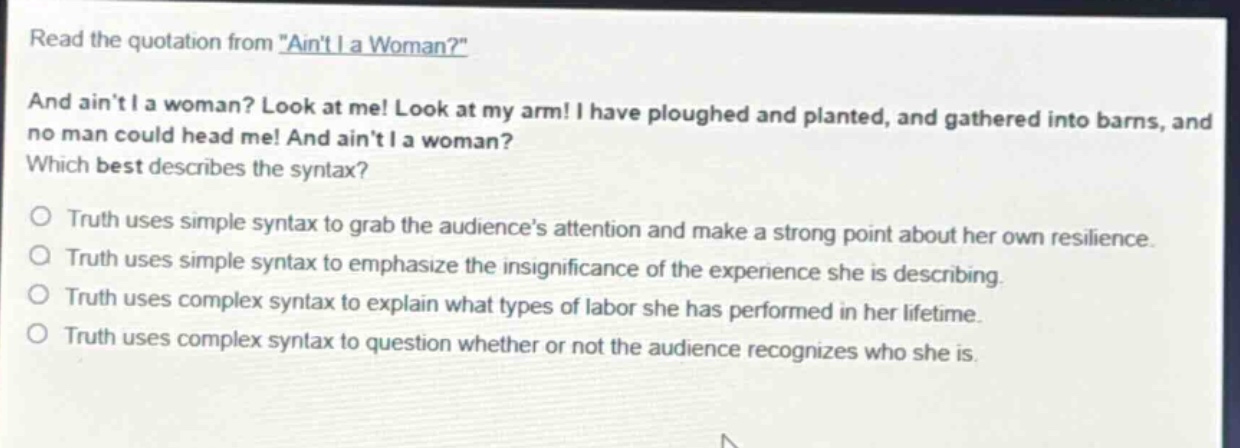
read the quotation from \aint i a woman?\ and aint i a woman? look at me! look at my arm! i have ploughed and planted, and gathered into barns, and no man could head me! and aint i a woman? which best describes the syntax? truth uses simple syntax to grab the audiences attention and make a strong point about her own resilience. truth uses simple syntax to emphasize the insignificance of the experience she is describing. truth uses complex syntax to explain what types of labor she has performed in her lifetime. truth uses complex syntax to question whether or not the audience recognizes who she is.
Answer
Brief Explanations:
The syntax in the quote is simple. The repetition of "And ain't I a woman?" and straightforward descriptions of her work emphasize her strength and resilience. It grabs the audience's attention.
Answer:
Truth uses simple syntax to grab the audience’s attention and make a strong point about her own resilience.