read the quotation from \a hymn to the evening\. \let placid slumbers sooth each weary mind, at morn to wake…
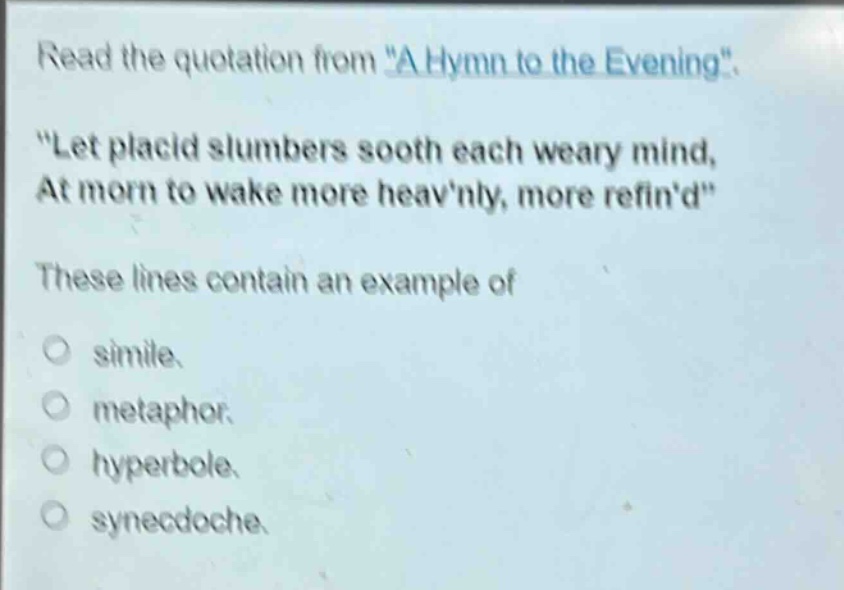
read the quotation from \a hymn to the evening\. \let placid slumbers sooth each weary mind, at morn to wake more heavnly, more refind\ these lines contain an example of\no simile.\no metaphor.\no hyperbole.\no synecdoche.
Answer
Brief Explanations:
A simile uses "like" or "as" for comparison. Here there is no such usage. A metaphor directly equates two things without "like" or "as", which isn't present either. A hyperbole is an extreme exaggeration, not evident here. Synecdoche is a figure - of - speech where a part represents the whole or vice - versa, also not applicable. However, the lines don't fit simile, metaphor, hyperbole, or synecdoche. But if we consider the closest in terms of common poetic devices, it's not any of the given ones in a strict sense.
Answer:
None of the above options are correct based on a strict analysis of the poetic device used in these lines.