the real issue is that the use of nuclear power and nuclear weapons is forcing humankind, and indeed the…
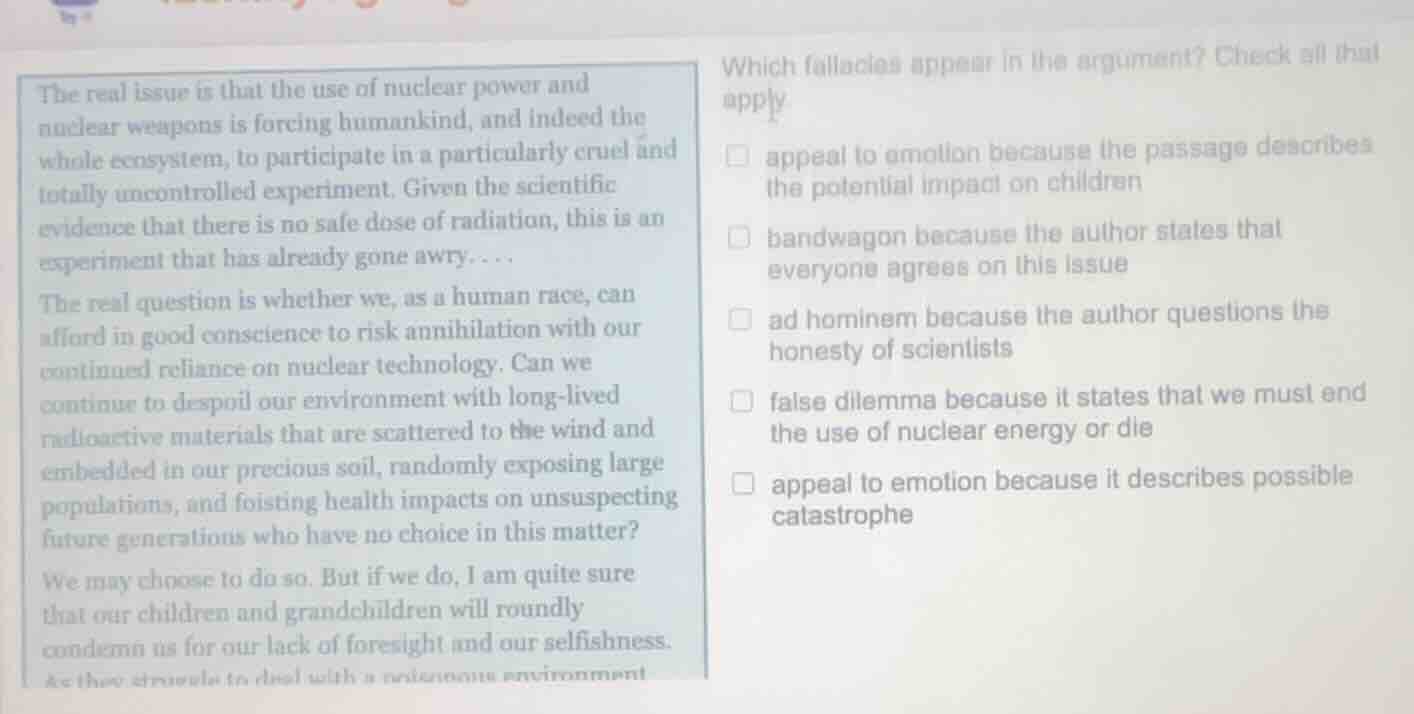
the real issue is that the use of nuclear power and nuclear weapons is forcing humankind, and indeed the whole ecosystem, to participate in a particularly cruel and totally uncontrolled experiment. given the scientific evidence that there is no safe dose of radiation, this is an experiment that has already gone awry....\nthe real question is whether we, as a human race, can afford in good conscience to risk annihilation with our continued reliance on nuclear technology. can we continue to despoil our environment with long-lived radioactive materials that are scattered to the wind and embedded in our precious soil, randomly exposing large populations, and foisting health impacts on unsuspecting future generations who have no choice in this matter?\nwe may choose to do so. but if we do, i am quite sure that our children and grandchildren will roundly condemn us for our lack of foresight and our selfishness.\n\nwhich fallacies appear in the argument? check all that apply\n□ appeal to emotion because the passage describes the potential impact on children\n□ bandwagon because the author states that everyone agrees on this issue\n□ ad hominem because the author questions the honesty of scientists\n□ false dilemma because it states that we must end the use of nuclear energy or die\n□ appeal to emotion because it describes possible catastrophe
Answer
Brief Explanations:
- Appeal to emotion (catastrophe): The passage uses dramatic, fear-inducing language like "cruel and totally uncontrolled experiment," "risk annihilation," "despoil our environment," and "possible catastrophe" to evoke strong negative emotions rather than relying solely on logical argument.
- Appeal to emotion (children): It references harm to "unsuspecting future generations" and condemnation by "our children and grandchildren," using the well-being of vulnerable groups to trigger emotional responses.
- False dilemma: The argument frames the choice as either ending nuclear technology or facing annihilation/condemnation, ignoring potential middle-ground options like safer nuclear power regulation or incremental phase-outs.
- The passage does not use bandwagon (it never claims everyone agrees) or ad hominem (it does not attack scientists' character).
Answer:
- appeal to emotion because the passage describes the potential impact on children
- false dilemma because it states that we must end the use of nuclear energy or die
- appeal to emotion because it describes possible catastrophe