10. cell theory has three parts. fill in the blanks. all living things are made of _____________. the cell…
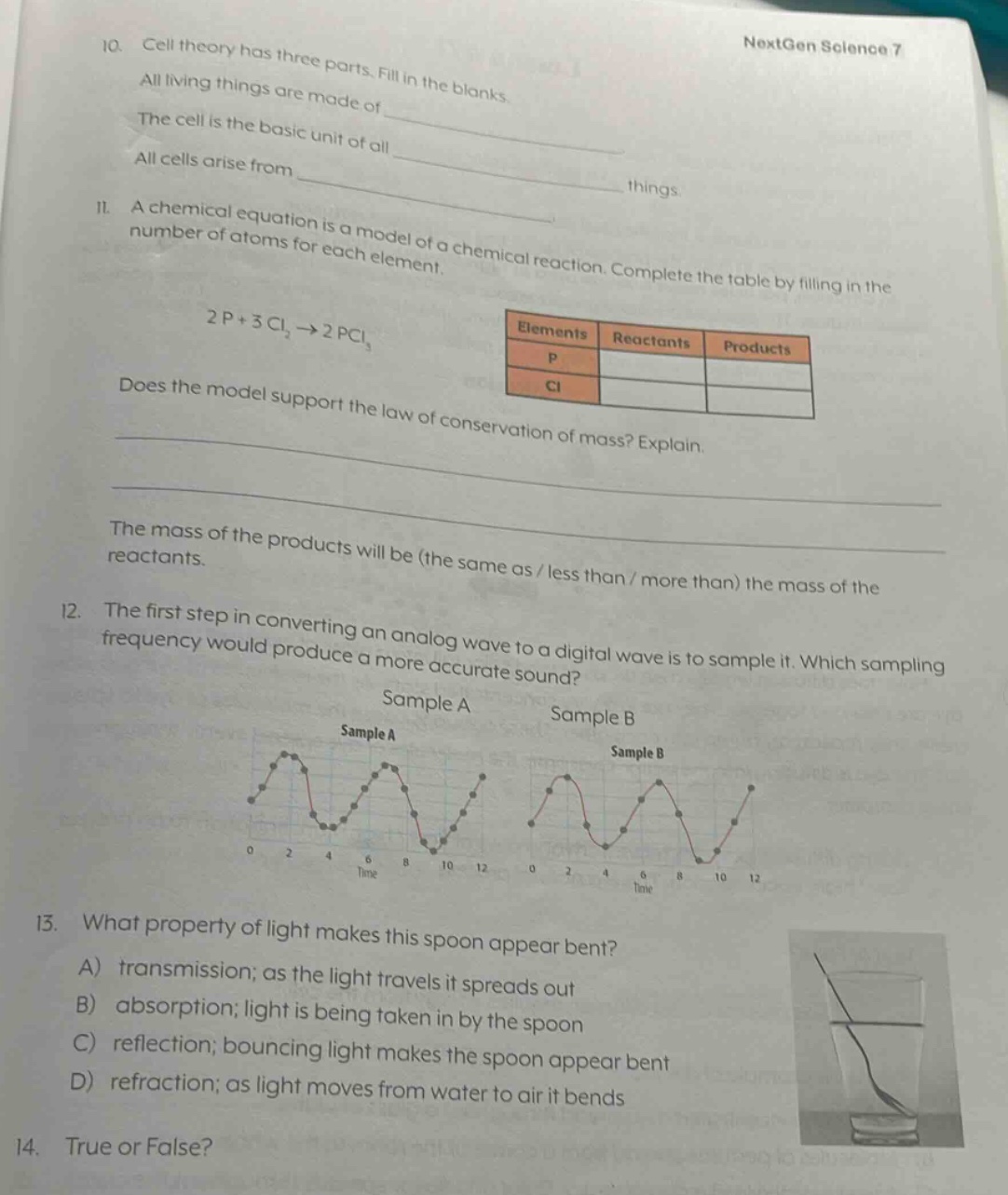
10. cell theory has three parts. fill in the blanks. all living things are made of _____________. the cell is the basic unit of all _____________. all cells arise from _____________. 11. a chemical equation is a model of a chemical reaction. complete the table by filling in the number of atoms for each element. 2p + 3cl₂→2pcl₃ elements reactants products p cl does the model support the law of conservation of mass? explain. the mass of the products will be (the same as / less than / more than) the mass of the reactants. 12. the first step in converting an analog wave to a digital wave is to sample it. which sampling frequency would produce a more accurate sound? sample a sample b 13. what property of light makes this spoon appear bent? a) transmission; as the light travels it spreads out b) absorption; light is being taken in by the spoon c) reflection; bouncing light makes the spoon appear bent d) refraction; as light moves from water to air it bends 14. true or false?
Answer
10.
Brief Explanations:
Cell theory states all living things are made of cells, the cell is the basic unit of life, and all cells come from pre - existing cells.
Answer:
All living things are made of cells. The cell is the basic unit of all living things. All cells arise from pre - existing cells.
11.
Explanation:
Step1: Count P atoms in reactants
In the reactant side of the equation $2P + 3Cl_2\rightarrow2PCl_3$, the coefficient of $P$ is 2, so the number of $P$ atoms in reactants is 2.
Step2: Count P atoms in products
In the product side, the coefficient of $PCl_3$ is 2, and since there is 1 $P$ atom in each $PCl_3$ molecule, the number of $P$ atoms in products is 2.
Step3: Count Cl atoms in reactants
In the reactant side, the coefficient of $Cl_2$ is 3, and since each $Cl_2$ molecule has 2 $Cl$ atoms, the number of $Cl$ atoms in reactants is $3\times2 = 6$.
Step4: Count Cl atoms in products
In the product side, the coefficient of $PCl_3$ is 2, and since each $PCl_3$ molecule has 3 $Cl$ atoms, the number of $Cl$ atoms in products is $2\times3=6$.
Step5: Check law of conservation of mass
The law of conservation of mass states that the total mass of reactants equals the total mass of products. Since the number of atoms of each element is the same on both sides of the equation, the mass is conserved.
Answer:
| Elements | Reactants | Products |
|---|---|---|
| P | 2 | 2 |
| Cl | 6 | 6 |
| Yes, the model supports the law of conservation of mass because the number of atoms of each element is the same on the reactant and product sides. | ||
| The mass of the products will be the same as the mass of the reactants. |
12.
Brief Explanations:
A higher sampling frequency provides more data points and thus a more accurate representation of the analog wave. Sample A has more data points (more frequent sampling) than Sample B.
Answer:
Sample A
13.
Brief Explanations:
When light moves from one medium (water) to another (air), it changes speed and direction, which is called refraction. This makes the spoon appear bent.
Answer:
D) refraction; as light moves from water to air it bends