10. describe a sequence of transformations that shows that quadrilateral rstu is similar to quadrilateral…
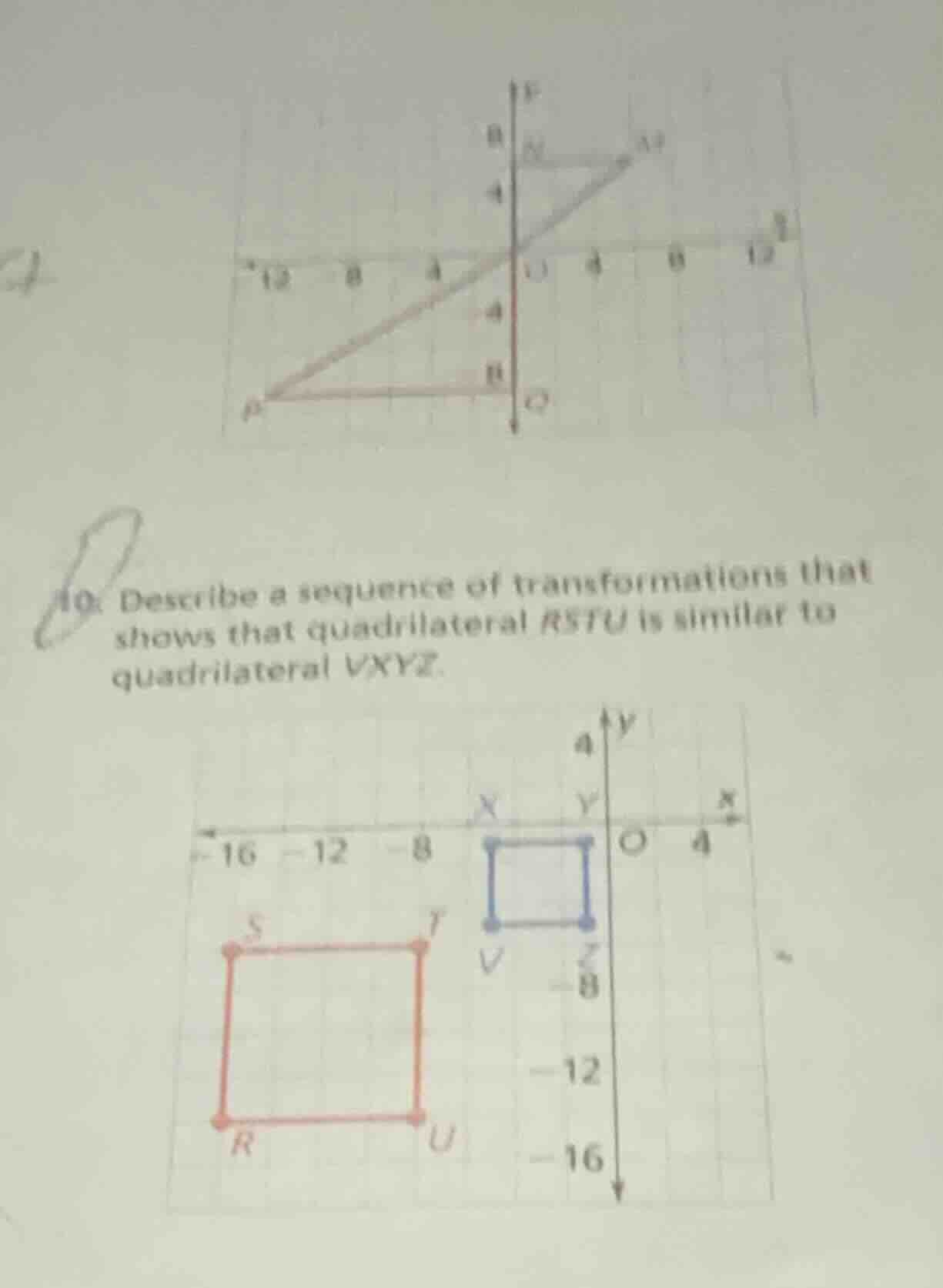
10. describe a sequence of transformations that shows that quadrilateral rstu is similar to quadrilateral vxyz.
Answer
Explanation:
Step1: Analyze the size relationship
First, observe the side lengths of the two quadrilaterals. Let's assume the side length of quadrilateral ( VXYZ ) is ( s ), and the side length of quadrilateral ( RSTU ) is ( 3s ) (by counting the grid units, we can find the scale factor). So we can perform a dilation first. The scale factor ( k ) can be determined by comparing the corresponding side lengths. If we take the horizontal side of ( VXYZ ), from ( X(-4, -4) ) to ( Y(0, -4) ), the length is ( 4 ) units. The horizontal side of ( RSTU ), say from ( R(-12, -16) ) to ( U(-4, -16) ), the length is ( 8 )? Wait, maybe I made a mistake. Wait, let's re - check. Let's take the coordinates: For ( VXYZ ), let's find the coordinates of the vertices. From the graph, ( V(-4, -8) ), ( X(-4, -4) ), ( Y(0, -4) ), ( Z(0, -8) ). So the length of ( VX ) (vertical side) is ( |-4 - (-8)|=4 ), and the length of ( XY ) (horizontal side) is ( |0 - (-4)| = 4 ). For ( RSTU ), let's assume ( R(-12, -16) ), ( S(-12, -8) ), ( T(-4, -8) ), ( U(-4, -16) ). Then the length of ( RS ) (vertical side) is ( |-8-(-16)| = 8 ), and the length of ( ST ) (horizontal side) is ( |-4 - (-12)|=8 ). Wait, no, maybe the scale factor is ( 2 )? Wait, no, let's calculate the scale factor correctly. The length of ( VX ) is ( 4 ) (from ( y=-8 ) to ( y = - 4)), and the length of ( RS ) is ( 8 ) (from ( y=-16 ) to ( y=-8 ))? Wait, maybe I misread the coordinates. Alternatively, let's use the grid. Let's assume the side length of ( VXYZ ) is ( 4 ) units (since from ( x=-4 ) to ( x = 0 ) is ( 4 ) units horizontally, and from ( y=-8 ) to ( y=-4 ) is ( 4 ) units vertically). The side length of ( RSTU ): from ( x=-12 ) to ( x=-4 ) is ( 8 ) units horizontally, and from ( y=-16 ) to ( y=-8 ) is ( 8 ) units vertically. So the scale factor ( k=\frac{8}{4}=2 )? Wait, no, ( 8\div4 = 2 )? Wait, ( 8) is the length of ( RSTU)'s side and ( 4) is the length of ( VXYZ)'s side, so the scale factor for dilation (enlargement) is ( 2 )? Wait, no, if we want to go from ( VXYZ ) to ( RSTU ), we need to dilate ( VXYZ ) by a scale factor. Let's calculate the ratio of corresponding sides. The length of ( XY ) (in ( VXYZ )): ( X(-4,-4) ), ( Y(0,-4) ), so length ( = 0 - (-4)=4 ). The length of ( ST ) (in ( RSTU )): ( S(-12,-8) ), ( T(-4,-8) ), length (=-4-(-12) = 8 ). So the ratio of ( ST) to ( XY) is ( \frac{8}{4}=2 ). So the scale factor ( k = 2 ). So first, we can dilate quadrilateral ( VXYZ ) with a scale factor of ( 2 ) centered at the origin. The rule for dilation centered at the origin is ( (x,y)\to(kx,ky) ). So for ( V(-4,-8) ), after dilation ( ( - 4\times2,-8\times2)=(-8,-16) )? No, that's not matching. Wait, maybe the center of dilation is not the origin. Alternatively, maybe we should translate first. Wait, let's think about the transformation steps.
Step2: Dilation
First, we can perform a dilation on quadrilateral ( VXYZ ) to make its size match ( RSTU ). Let's find the scale factor. Let's take the vertical side of ( VXYZ ): from ( y=-8 ) to ( y=-4 ), length ( l_1 = 4 ). The vertical side of ( RSTU ): from ( y=-16 ) to ( y=-8 ), length ( l_2=8 ). So the scale factor ( k=\frac{l_2}{l_1}=\frac{8}{4} = 2 ). So we dilate ( VXYZ ) with a scale factor of ( 2 ) centered at the origin. The coordinates of ( V(-4,-8) ) after dilation: ( (-4\times2,-8\times2)=(-8,-16) ), ( X(-4,-4) ) after dilation: ( (-4\times2,-4\times2)=(-8,-8) ), ( Y(0,-4) ) after dilation: ( (0\times2,-4\times2)=(0,-8) ), ( Z(0,-8) ) after dilation: ( (0\times2,-8\times2)=(0,-16) ). But the coordinates of ( RSTU ) are ( R(-12,-16) ), ( S(-12,-8) ), ( T(-4,-8) ), ( U(-4,-16) ). So after dilation, we need to translate.
Step3: Translation
The dilated figure has vertices ( (-8,-16) ), ( (-8,-8) ), ( (0,-8) ), ( (0,-16) ). We need to translate this figure to get to ( RSTU ) with vertices ( (-12,-16) ), ( (-12,-8) ), ( (-4,-8) ), ( (-4,-16) ). The horizontal translation: from ( x=-8 ) to ( x=-12 ), we need to move ( - 4 ) units (i.e., 4 units to the left). The vertical translation: from ( y=-16 ) (for the first vertex) to ( y=-16 ), no vertical translation. So the translation vector is ( (-4,0) ).
So the sequence of transformations is: First, dilate quadrilateral ( VXYZ ) with a scale factor of ( 2 ) centered at the origin, then translate the resulting figure ( 4 ) units to the left (or we can also translate first and then dilate, but the order may vary as long as the similarity is shown). Another way: We can also check the other way. Let's take quadrilateral ( RSTU ) and see how to get to ( VXYZ ). The side length of ( RSTU ) (horizontal side from ( R(-12,-16) ) to ( U(-4,-16) )) is ( 8 ) units, and the horizontal side of ( VXYZ ) (from ( X(-4,-4) ) to ( Y(0,-4) )) is ( 4 ) units. So the scale factor for reducing ( RSTU ) to ( VXYZ ) is ( \frac{4}{8}=\frac{1}{2} ). Then we can translate. But the problem says "a sequence of transformations that shows that quadrilateral ( RSTU ) is similar to quadrilateral ( VXYZ )". So one possible sequence is: Dilate quadrilateral ( VXYZ ) by a scale factor of ( 2 ) centered at the origin, then translate the image ( 4 ) units to the left (or we can dilate ( RSTU ) by a scale factor of ( \frac{1}{2} ) and translate).
Alternatively, let's confirm the similarity. Similarity transformations include dilations, translations, rotations, and reflections. Since both figures are rectangles (all angles are right angles), we just need to show a dilation and a translation (or other rigid motions) to map one to the other.
Let's re - express the coordinates:
For ( VXYZ ):
- ( V(-4,-8) )
- ( X(-4,-4) )
- ( Y(0,-4) )
- ( Z(0,-8) )
For ( RSTU ):
- ( R(-12,-16) )
- ( S(-12,-8) )
- ( T(-4,-8) )
- ( U(-4,-16) )
Let's apply a dilation with scale factor ( 2 ) to ( VXYZ ):
- ( V'=(-4\times2,-8\times2)=(-8,-16) )
- ( X'=(-4\times2,-4\times2)=(-8,-8) )
- ( Y'=(0\times2,-4\times2)=(0,-8) )
- ( Z'=(0\times2,-8\times2)=(0,-16) )
Now, we need to translate the dilated figure ( V'X'Y'Z' ) to ( RSTU ). The vector from ( V'(-8,-16) ) to ( R(-12,-16) ) is ( (-12 - (-8),-16 - (-16))=(-4,0) ). So we translate the dilated figure ( 4 ) units to the left (in the ( x ) - direction, ( y ) - direction remains the same). After translation, ( V'(-8,-16)\to R(-12,-16) ), ( X'(-8,-8)\to S(-12,-8) ), ( Y'(0,-8)\to T(-4,-8) ), ( Z'(0,-16)\to U(-4,-16) ). So the sequence of transformations is: Dilate quadrilateral ( VXYZ ) by a scale factor of ( 2 ) centered at the origin, then translate the resulting quadrilateral ( 4 ) units to the left (or we can also rotate, but since both are axis - aligned rectangles, rotation is not needed here).
Another way: We can also reflect, but since both are in the same orientation (both have their sides parallel to the axes), reflection is not necessary. So the key is dilation (to change the size) and translation (to change the position) to map one to the other, showing similarity.
Answer:
One possible sequence of transformations is: First, dilate quadrilateral ( VXYZ ) with a scale factor of ( 2 ) centered at the origin. Then, translate the resulting quadrilateral ( 4 ) units to the left (in the ( x ) - direction, ( y ) - coordinate remains unchanged). This sequence of a dilation (a similarity transformation) and a translation (a rigid transformation) shows that quadrilateral ( RSTU ) is similar to quadrilateral ( VXYZ ). (Note: Other valid sequences are also possible, such as dilating ( RSTU ) with a scale factor of ( \frac{1}{2} ) and translating, or combining with other rigid motions like rotation/reflection if needed, but in this case, since the figures are axis - aligned, dilation and translation suffice.)