10 evaluate: 6^(-4) a. - 24 b. 1/24 c. - 1296 d. 1/1296 11 solve for x: x^2 = 196 a. 14 b. ±14 c. 98 d. ±98…
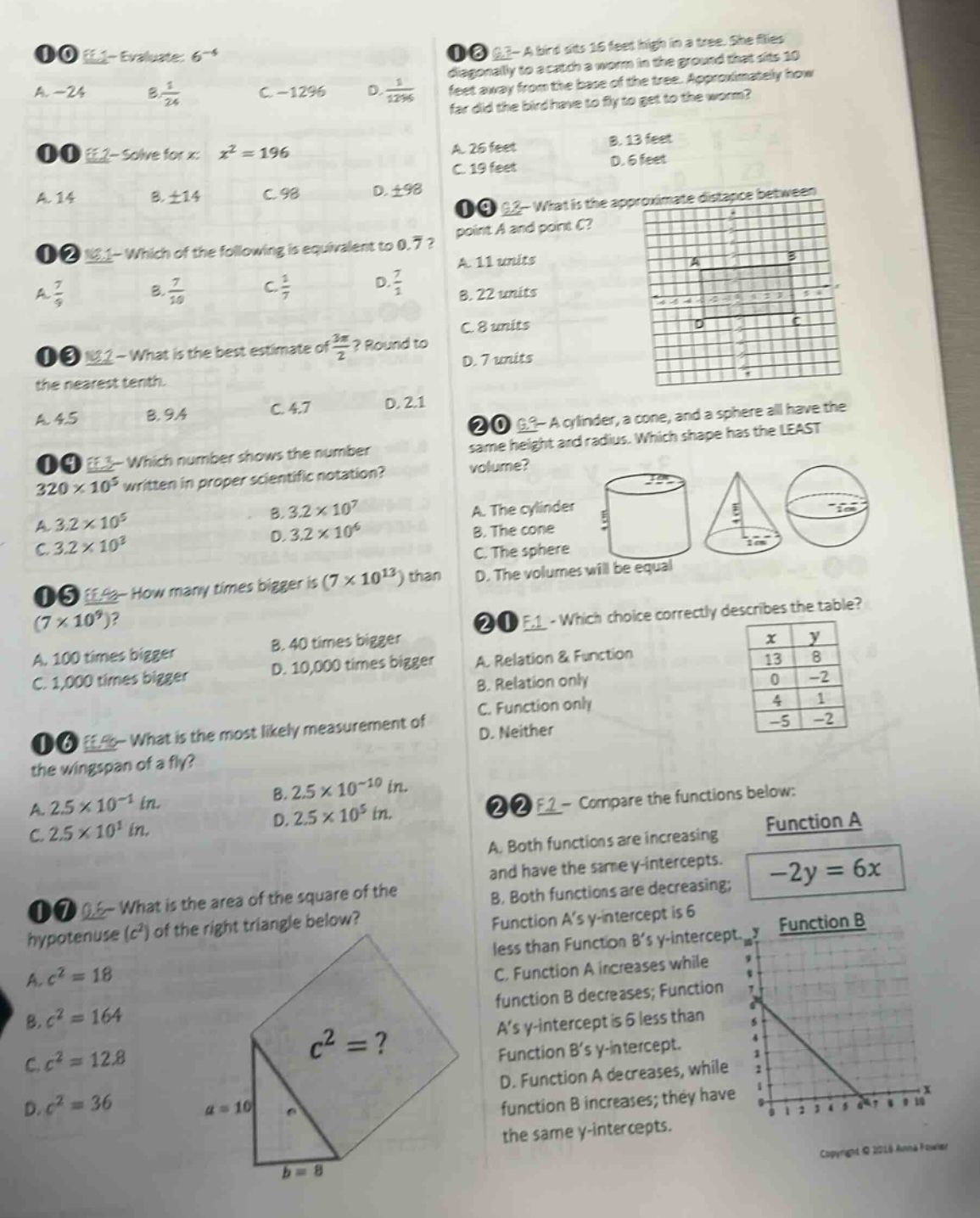
10 evaluate: 6^(-4) a. - 24 b. 1/24 c. - 1296 d. 1/1296 11 solve for x: x^2 = 196 a. 14 b. ±14 c. 98 d. ±98 12 which of the following is equivalent to 0.7̅? a. 7/9 b. 7/10 c. 1/7 d. 7/1 13 what is the best estimate of 3π/2? round to the nearest tenth. a. 4.5 b. 9.4 c. 4.7 d. 2.1 14 which number shows the number 320×10^5 written in proper scientific notation? a. 3.2×10^5 b. 3.2×10^7 c. 3.2×10^3 d. 3.2×10^6 15 how many times bigger is (7×10^13) than (7×10^9)? a. 100 times bigger b. 40 times bigger c. 1,000 times bigger d. 10,000 times bigger 16 what is the most likely measurement of the wingspan of a fly? a. 2.5×10^(-1) in. b. 2.5×10^(-10) in. c. 2.5×10^(1) in. d. 2.5×10^(5) in. 17 what is the area of the square of the hypotenuse (c^2) of the right triangle below? a. c^2 = 18 b. c^2 = 164 c. c^2 = 12.8 d. c^2 = 36 a = 10 b = 8 18 a bird sits 16 feet high in a tree. she flies diagonally to a catch a worm in the ground that sits 10 feet away from the base of the tree. approximately how far did the bird have to fly to get to the worm? a. 26 feet b. 13 feet c. 19 feet d. 6 feet 19 what is the approximate distance between point a and point c? a. 11 units b. 22 units c. 8 units d. 7 units 20 a cylinder, a cone, and a sphere all have the same height and radius. which shape has the least volume? a. the cylinder b. the cone c. the sphere d. the volumes will be equal 21 which choice correctly describes the table? a. relation & function b. relation only c. function only d. neither 22 compare the functions below: a. both functions are increasing and have the same y - intercepts. b. both functions are decreasing; function a’s y - intercept is 6 less than function b’s y - intercept. c. function a increases while function b decreases; function a’s y - intercept is 6 less than function b’s y - intercept. d. function a decreases, while function b increases; they have the same y - intercepts. function a - 2y = 6x function b
Answer
Answer:
- D. $\frac{1}{1296}$
- B. $\pm14$
- A. $\frac{7}{9}$
- C. $4.7$
- B. $3.2\times10^{7}$
- D. 10,000 times bigger
- A. $2.5\times10^{-1}$ in.
- B. $c^{2}=164$
- C. 19 feet
- A. 11 units
- B. The cone
- A. Relation & Function
- D. Function A decreases, while function B increases; they have the same y - intercepts.
Explanation:
Step1: Evaluate 6^(-4)
Use negative - exponent rule $a^{-n}=\frac{1}{a^{n}}$, so $6^{-4}=\frac{1}{6^{4}}=\frac{1}{1296}$.
Step2: Solve $x^{2}=196$
Take square root of both sides, $x = \pm\sqrt{196}=\pm14$.
Step3: Find equivalent of 0.777...
Let $x = 0.\overline{7}$, then $10x=7.\overline{7}$, $10x - x=7.\overline{7}-0.\overline{7}$, $9x = 7$, $x=\frac{7}{9}$.
Step4: Estimate $\frac{3\pi}{2}$
$\pi\approx3.14$, so $\frac{3\pi}{2}=\frac{3\times3.14}{2}=4.71\approx4.7$.
Step5: Write 320×10^5 in scientific notation
$320\times10^{5}=3.2\times10^{2}\times10^{5}=3.2\times10^{7}$.
Step6: Find how many times $(7\times10^{13})$ is bigger than $(7\times10^{9})$
$\frac{7\times10^{13}}{7\times10^{9}} = 10^{13 - 9}=10^{4}=10000$.
Step7: Choose wing - span of a fly
A fly's wing - span is small, $2.5\times10^{-1}$ in. is reasonable.
Step8: Find $c^{2}$ in right - triangle
By Pythagorean theorem $c^{2}=a^{2}+b^{2}$, $a = 10$, $b = 8$, so $c^{2}=10^{2}+8^{2}=100 + 64=164$.
Step9: Solve bird's flight distance
Use Pythagorean theorem. Height is 16 feet, horizontal distance is 10 feet. Distance $d=\sqrt{16^{2}+10^{2}}=\sqrt{256 + 100}=\sqrt{356}\approx19$ feet.
Step10: Find distance between A and C
Count the grid units. Horizontal change and vertical change and use distance formula (or count units directly), distance is 11 units.
Step11: Compare volumes
Volume of cylinder $V_{cylinder}=\pi r^{2}h$, volume of cone $V_{cone}=\frac{1}{3}\pi r^{2}h$, volume of sphere $V_{sphere}=\frac{4}{3}\pi r^{3}$ (with $h = 2r$ for sphere in this case). Cone has least volume.
Step12: Classify relation
Each x - value has a unique y - value, so it is a relation and a function.
Step13: Compare functions
Function A: $-2y = 6x$ or $y=-3x$, slope is - 3, y - intercept is 0. Function B: from graph, slope is negative, y - intercept is 0. Function A decreases, Function B increases, and they have same y - intercept.