1. 10.2 - exercises 43 - 46, find the angle θ between the vectors. u=(3, - 1, 6), v=(4, - 10, 1)\n2. 6.2…
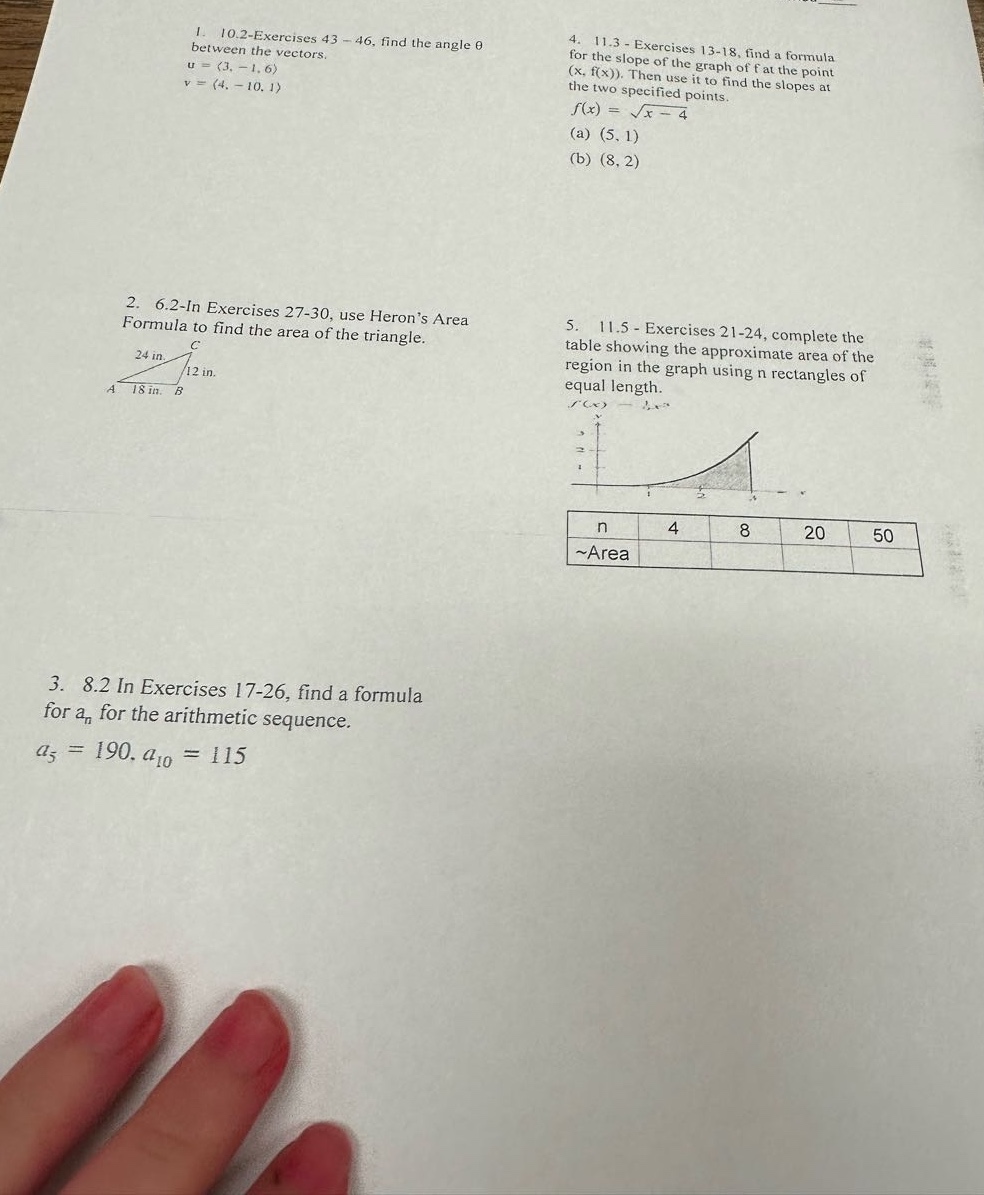
1. 10.2 - exercises 43 - 46, find the angle θ between the vectors. u=(3, - 1, 6), v=(4, - 10, 1)\n2. 6.2 - in exercises 27 - 30, use herons area formula to find the area of the triangle.\n3. 8.2 in exercises 17 - 26, find a formula for (a_n) for the arithmetic sequence. (a_5 = 190, a_{10}=115)\n4. 11.3 - exercises 13 - 18, find a formula for the slope of the graph of f at the point ((x,f(x))). then use it to find the slopes at the two specified points. (f(x)=sqrt{x - 4}) (a) ((5,1)) (b) ((8,2))\n5. 11.5 - exercises 21 - 24, complete the table showing the approximate area of the region in the graph using n rectangles of equal length.
Answer
- Finding the angle between vectors:
Explanation:
Step1: Recall dot - product formula
The dot - product of two vectors $\mathbf{u}=(u_1,u_2,u_3)$ and $\mathbf{v}=(v_1,v_2,v_3)$ is $\mathbf{u}\cdot\mathbf{v}=u_1v_1 + u_2v_2+u_3v_3$, and $\mathbf{u}\cdot\mathbf{v}=\vert\mathbf{u}\vert\vert\mathbf{v}\vert\cos\theta$, where $\theta$ is the angle between the vectors, $\vert\mathbf{u}\vert=\sqrt{u_1^{2}+u_2^{2}+u_3^{2}}$ and $\vert\mathbf{v}\vert=\sqrt{v_1^{2}+v_2^{2}+v_3^{2}}$. For $\mathbf{u}=(3, - 1,6)$ and $\mathbf{v}=(4,-10,1)$: $\mathbf{u}\cdot\mathbf{v}=3\times4+( - 1)\times(-10)+6\times1=12 + 10+6=28$ $\vert\mathbf{u}\vert=\sqrt{3^{2}+(-1)^{2}+6^{2}}=\sqrt{9 + 1+36}=\sqrt{46}$ $\vert\mathbf{v}\vert=\sqrt{4^{2}+(-10)^{2}+1^{2}}=\sqrt{16 + 100+1}=\sqrt{117}$
Step2: Solve for $\theta$
Since $\mathbf{u}\cdot\mathbf{v}=\vert\mathbf{u}\vert\vert\mathbf{v}\vert\cos\theta$, then $\cos\theta=\frac{\mathbf{u}\cdot\mathbf{v}}{\vert\mathbf{u}\vert\vert\mathbf{v}\vert}=\frac{28}{\sqrt{46}\sqrt{117}}$. $\theta=\arccos\left(\frac{28}{\sqrt{46}\sqrt{117}}\right)$
- Using Heron's formula to find the area of a triangle: Let $a = 18$, $b = 12$, $c = 24$.
Explanation:
Step1: Calculate the semi - perimeter $s$
The semi - perimeter $s=\frac{a + b + c}{2}=\frac{18+12 + 24}{2}=\frac{54}{2}=27$.
Step2: Apply Heron's formula
Heron's formula is $A=\sqrt{s(s - a)(s - b)(s - c)}$. $A=\sqrt{27(27 - 18)(27 - 12)(27 - 24)}=\sqrt{27\times9\times15\times3}=\sqrt{9\times3\times9\times15\times3}= \sqrt{9^{2}\times3^{2}\times15}=9\times3\sqrt{15}=27\sqrt{15}\text{ in}^2$
- Finding the formula for an arithmetic sequence:
Explanation:
Step1: Recall the formula for the $n$th term of an arithmetic sequence
The formula for the $n$th term of an arithmetic sequence is $a_n=a_1+(n - 1)d$, where $a_1$ is the first term and $d$ is the common difference. We know that $a_5=a_1+(5 - 1)d=a_1 + 4d=190$ and $a_{10}=a_1+(10 - 1)d=a_1+9d=115$. Subtract the first equation from the second: $(a_1 + 9d)-(a_1 + 4d)=115 - 190$. $5d=-75$, so $d=-15$.
Step2: Find $a_1$
Substitute $d=-15$ into $a_1 + 4d=190$. $a_1+4\times(-15)=190$, $a_1-60 = 190$, $a_1=250$. The formula for $a_n$ is $a_n=250+(n - 1)(-15)=250-15n + 15=265-15n$.
- Finding the slope of a function: The function is $f(x)=\sqrt{x - 4}=(x - 4)^{\frac{1}{2}}$.
Explanation:
Step1: Find the derivative using the power rule
The power rule states that if $y = u^n$, then $y^\prime=nu^{n - 1}u^\prime$. Here $u=x - 4$, $n=\frac{1}{2}$, and $u^\prime = 1$. $f^\prime(x)=\frac{1}{2}(x - 4)^{-\frac{1}{2}}=\frac{1}{2\sqrt{x - 4}}$.
Step2: Find the slopes at the given points
(a) When $x = 5$, $f^\prime(5)=\frac{1}{2\sqrt{5 - 4}}=\frac{1}{2}$. (b) When $x = 8$, $f^\prime(8)=\frac{1}{2\sqrt{8 - 4}}=\frac{1}{2\times2}=\frac{1}{4}$.
- Approximating the area under a curve using rectangles: Let's assume the function is $y = f(x)$ (not fully given in the problem, but we use the general Riemann - sum approach). The width of each rectangle $\Delta x=\frac{b - a}{n}$, where $[a,b]$ is the interval over which we are approximating the area.
Explanation:
Step1: General Riemann - sum formula
The left - hand Riemann sum is $L_n=\sum_{i = 0}^{n - 1}f(x_i)\Delta x$, the right - hand Riemann sum is $R_n=\sum_{i = 1}^{n}f(x_i)\Delta x$, and the mid - point Riemann sum is $M_n=\sum_{i = 0}^{n - 1}f\left(\frac{x_i+x_{i + 1}}{2}\right)\Delta x$. Without knowing the function and the interval $[a,b]$, we can't calculate the exact values. But if we assume a left - hand Riemann sum for simplicity, and say the interval is $[a,b]$, then $\Delta x=\frac{b - a}{n}$. For example, if we assume the function is $y = x^2$ on $[0,2]$: When $n = 4$, $\Delta x=\frac{2-0}{4}=0.5$. The left - hand sum $L_4=f(0)\times0.5+f(0.5)\times0.5+f(1)\times0.5+f(1.5)\times0.5=(0^{2}+0.5^{2}+1^{2}+1.5^{2})\times0.5=(0 + 0.25+1+2.25)\times0.5=3.5\times0.5 = 1.75$. When $n = 8$, $\Delta x=\frac{2-0}{8}=0.25$, and we calculate the sum in a similar fashion.
Since the function is not given, we can't give exact numerical answers for the table. But the general process is to calculate $\Delta x=\frac{b - a}{n}$ and then use a Riemann - sum formula (left - hand, right - hand or mid - point) to find the approximate area.
Answer:
- $\theta=\arccos\left(\frac{28}{\sqrt{46}\sqrt{117}}\right)$
- $27\sqrt{15}\text{ in}^2$
- $a_n=265-15n$
- (a) $\frac{1}{2}$; (b) $\frac{1}{4}$
- Without the function and the interval, exact values can't be calculated. General process: Calculate $\Delta x=\frac{b - a}{n}$ and use a Riemann - sum formula (left - hand, right - hand or mid - point) to find the approximate area.