10. matrices a and b are given below. (a = \begin{bmatrix}-3&2end{bmatrix}), (b=\begin{bmatrix}7&…
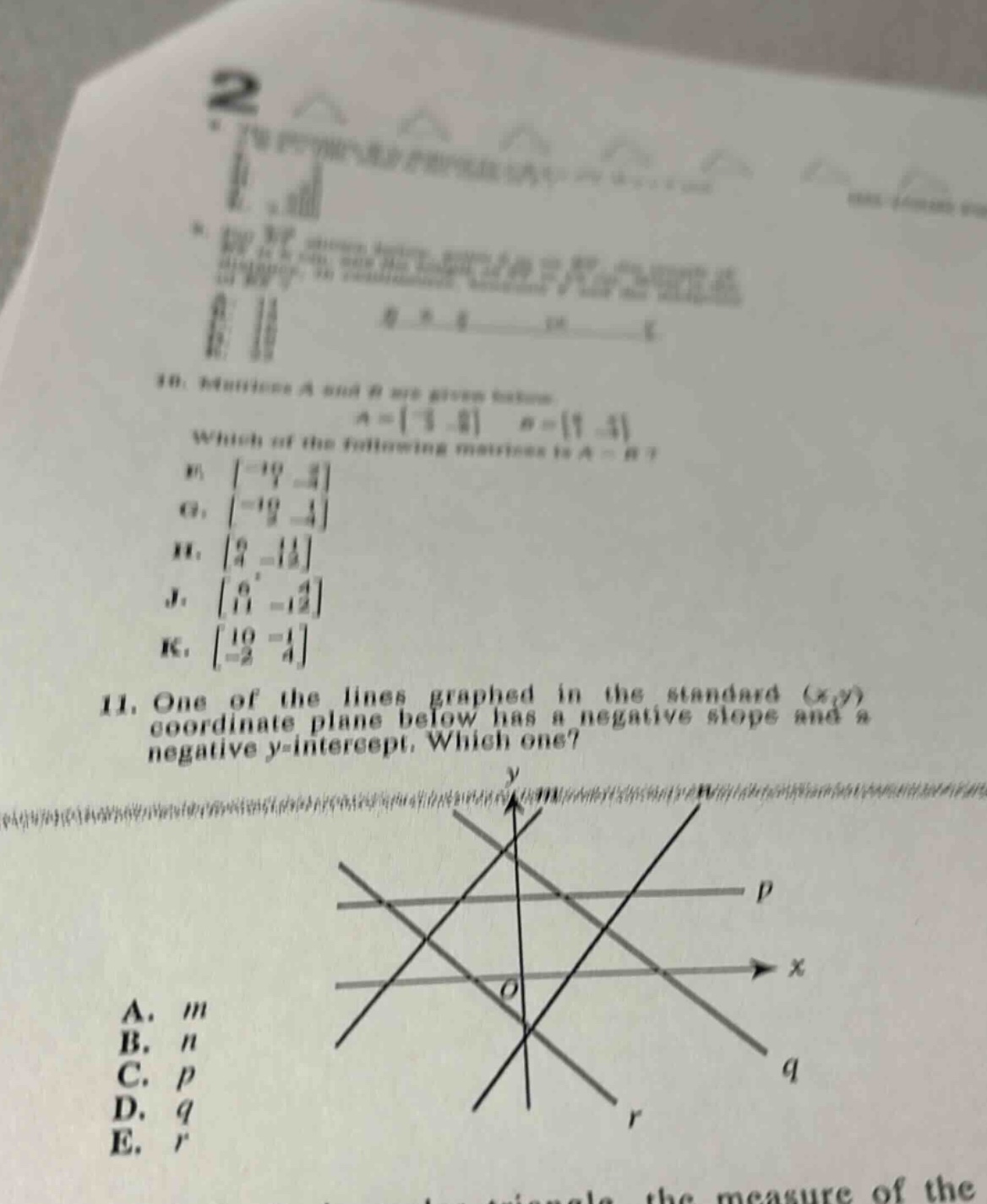
10. matrices a and b are given below. (a = \begin{bmatrix}-3&2end{bmatrix}), (b=\begin{bmatrix}7& - 4end{bmatrix}). which of the following matrices is (a - b)? f. (\begin{bmatrix}-10&6end{bmatrix}) g. (\begin{bmatrix}-10& - 2end{bmatrix}) h. (\begin{bmatrix}4& - 2end{bmatrix}) j. (\begin{bmatrix}4& - 6end{bmatrix}) k. (\begin{bmatrix}10& - 1\\-2&4end{bmatrix}) 11. one of the lines graphed in the standard ((x,y)) - coordinate plane below has a negative slope and a negative (y) - intercept. which one? a. (m) b. (n) c. (p) d. (q) e. (r)
Answer
Explanation:
Step1: Calculate matrix (A - B)
Given (A=\begin{bmatrix}- 3&8\end{bmatrix}) and (B = \begin{bmatrix}7& - 4\end{bmatrix}), for matrix - subtraction, we subtract the corresponding elements. So (A - B=\begin{bmatrix}-3 - 7&8-(-4)\end{bmatrix}=\begin{bmatrix}-10&12\end{bmatrix}). There is no such option for this part in the provided choices for matrix subtraction.
Step2: Analyze the slope - intercept form of a line (y = mx + b)
The slope - intercept form of a line is (y=mx + b), where (m) is the slope and (b) is the (y) - intercept.
- Line (m): It has a positive slope ((m>0)) and a positive (y) - intercept ((b > 0)).
- Line (n): It has an undefined slope (vertical line, (x = c) form).
- Line (p): It has a slope of (m = 0) (horizontal line, (y=c) form).
- Line (q): It has a negative slope ((m<0)) and a positive (y) - intercept ((b>0)).
- Line (r): It has a negative slope ((m < 0)) and a negative (y) - intercept ((b<0)).
Answer:
- No correct option shown for matrix subtraction.
- E. (r)