11 the formula for the area of a triangle is area = 1/2 × base × height. how much greater is the area of…
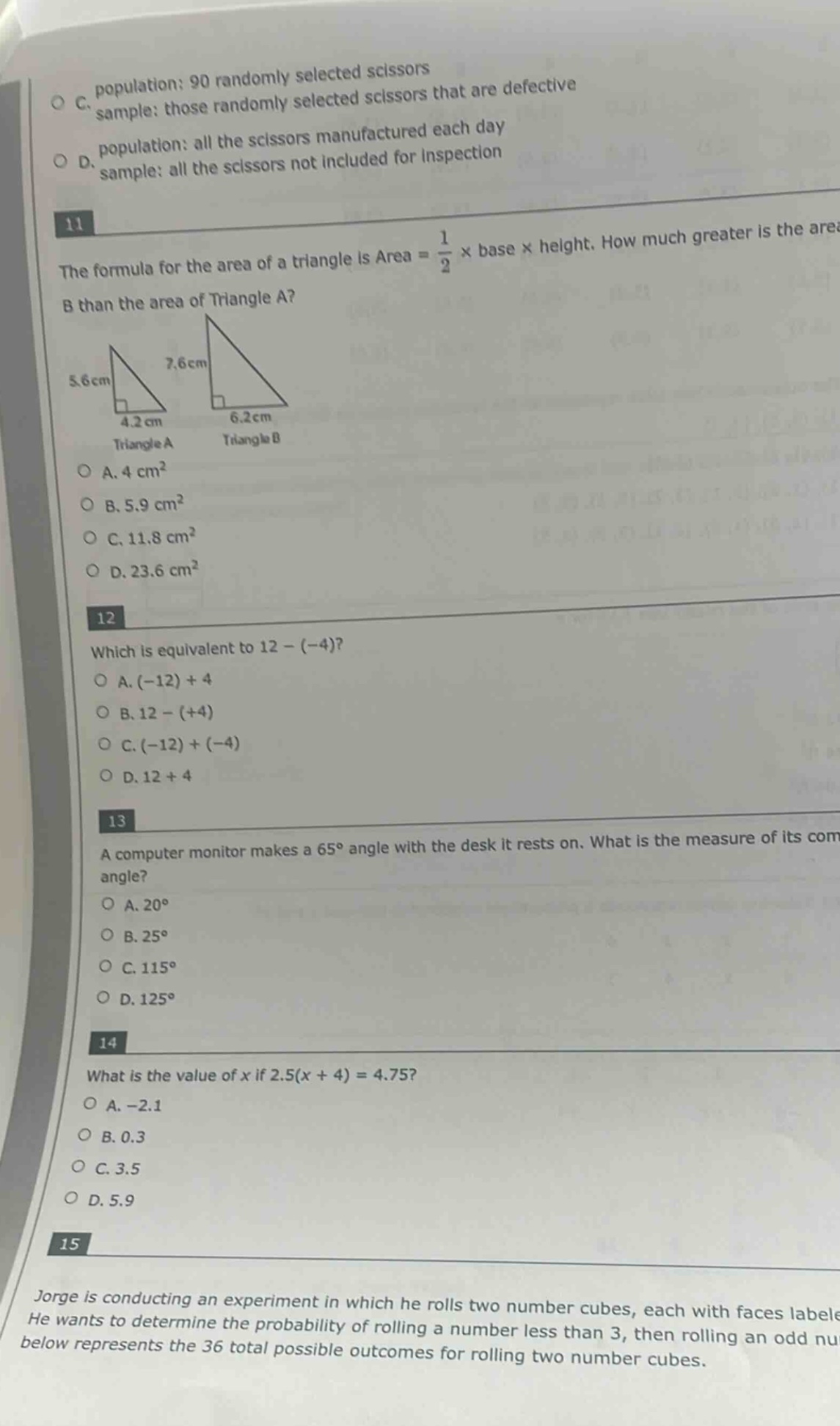
11 the formula for the area of a triangle is area = 1/2 × base × height. how much greater is the area of triangle b than the area of triangle a? 5.6cm 7.6cm 4.2cm 6.2cm triangle a triangle b o a. 4 cm² o b. 5.9 cm² o c. 11.8 cm² o d. 23.6 cm² 12 which is equivalent to 12 - (-4)? o a. (-12) + 4 o b. 12 - (+4) o c. (-12) + (-4) o d. 12 + 4 13 a computer monitor makes a 65° angle with the desk it rests on. what is the measure of its complementary angle? o a. 20° o b. 25° o c. 115° o d. 125° 14 what is the value of x if 2.5(x + 4) = 4.75? o a. -2.1 o b. 0.3 o c. 3.5 o d. 5.9 15 jorge is conducting an experiment in which he rolls two number cubes, each with faces labeled. he wants to determine the probability of rolling a number less than 3, then rolling an odd number. the table below represents the 36 total possible outcomes for rolling two number cubes.
Answer
11
Answer:
B. $5.9\ cm^{2}$
Explanation:
Step1: Calculate area of Triangle A
$A_{A}=\frac{1}{2}\times4.2\times5.6 = 11.76\ cm^{2}$
Step2: Calculate area of Triangle B
$A_{B}=\frac{1}{2}\times6.2\times7.6= 23.56\ cm^{2}$
Step3: Find the difference
$A_{B}-A_{A}=23.56 - 11.76=5.9\ cm^{2}$
12
Answer:
D. $12 + 4$
Explanation:
Step1: Apply subtraction - rule
Subtracting a negative number is the same as adding its positive counterpart. So $12-(-4)=12 + 4$.
13
Answer:
B. $25^{\circ}$
Explanation:
Step1: Recall complementary - angle concept
Complementary angles add up to $90^{\circ}$.
Step2: Calculate the complementary angle
Let the complementary angle be $x$. Then $x=90^{\circ}-65^{\circ}=25^{\circ}$.
14
Answer:
A. $- 2.1$
Explanation:
Step1: Distribute on left - hand side
$2.5(x + 4)=2.5x+10$. So the equation becomes $2.5x+10 = 4.75$.
Step2: Isolate the variable term
Subtract 10 from both sides: $2.5x=4.75 - 10=-5.25$.
Step3: Solve for x
Divide both sides by 2.5: $x=\frac{-5.25}{2.5}=-2.1$.