15. \begin{bmatrix} -1&2\\2& - 1 end{bmatrix}\begin{bmatrix} x\\y end{bmatrix}=\begin{bmatrix} 11\\-10…
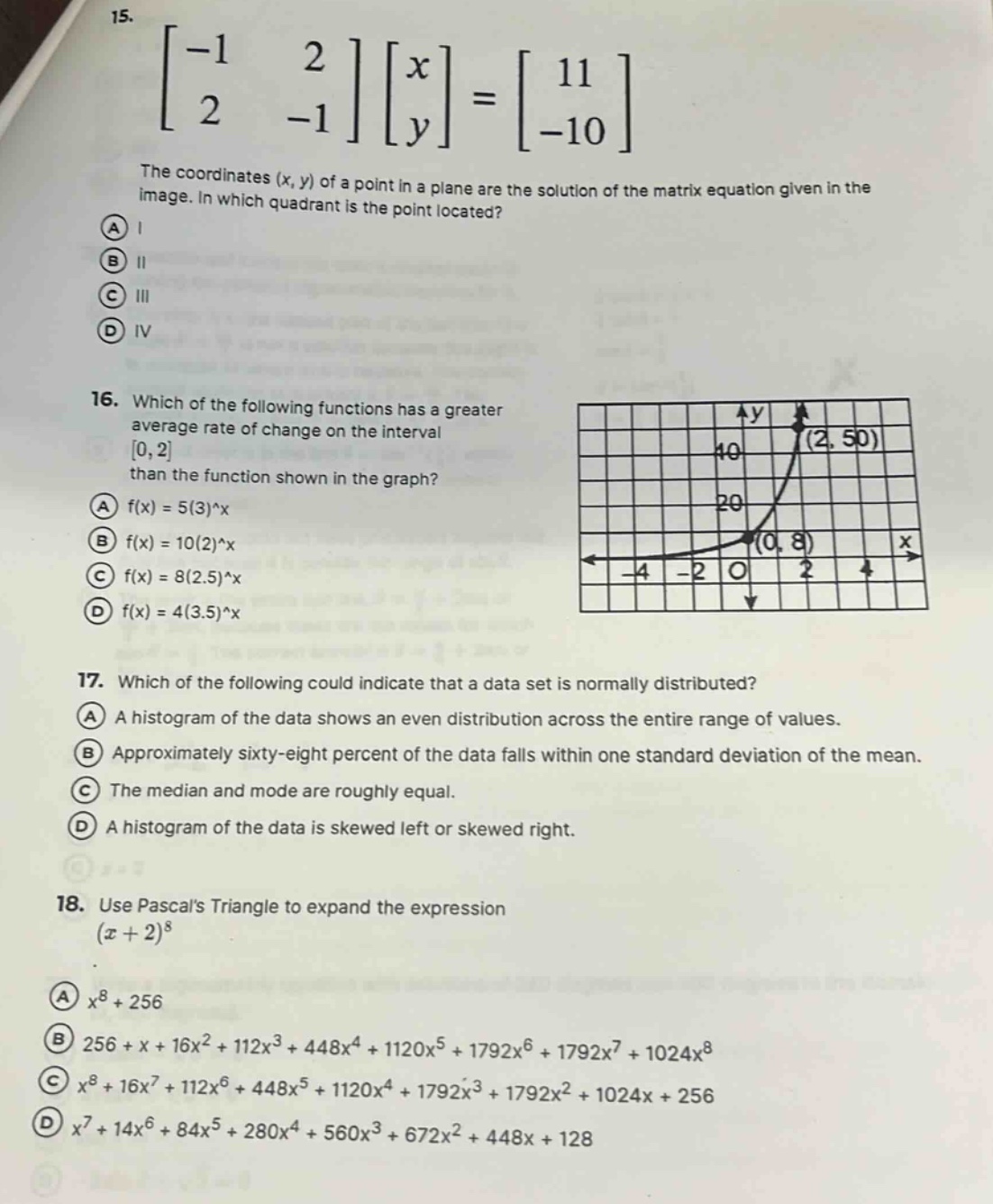
15. \begin{bmatrix} -1&2\\2& - 1 end{bmatrix}\begin{bmatrix} x\\y end{bmatrix}=\begin{bmatrix} 11\\-10 end{bmatrix}\nthe coordinates (x, y) of a point in a plane are the solution of the matrix equation given in the image. in which quadrant is the point located?\na i\nb ii\nc iii\nd iv\n16. which of the following functions has a greater average rate of change on the interval (0,2) than the function shown in the graph?\na (f(x)=5(3)^x)\nb (f(x)=10(2)^x)\nc (f(x)=8(2.5)^x)\nd (f(x)=4(3.5)^x)\n17. which of the following could indicate that a data set is normally distributed?\na a histogram of the data shows an even distribution across the entire range of values.\nb approximately sixty - eight percent of the data falls within one standard deviation of the mean.\nc the median and mode are roughly equal.\nd a histogram of the data is skewed left or skewed right.\n18. use pascals triangle to expand the expression ((x + 2)^8)\na (x^8+256)\nb (256 + x+16x^2+112x^3+448x^4+1120x^5+1792x^6+1792x^7+1024x^8)\nc (x^8+16x^7+112x^6+448x^5+1120x^4+1792x^3+1792x^2+1024x + 256)\nd (x^7+14x^6+84x^5+280x^4+560x^3+672x^2+448x + 128)
Answer
15.
Explanation:
Step1: Solve the matrix - equation
The matrix equation (\begin{bmatrix}-1&2\2&-1\end{bmatrix}\begin{bmatrix}x\y\end{bmatrix}=\begin{bmatrix}11\ - 10\end{bmatrix}) can be written as a system of linear equations (-x + 2y=11) and (2x-y=-10). From the first - equation (x = 2y - 11). Substitute (x = 2y-11) into the second equation: (2(2y - 11)-y=-10). [ \begin{align*} 4y-22 - y&=-10\ 3y&=12\ y& = 4 \end{align*} ] Substitute (y = 4) into (x = 2y-11), then (x=2\times4 - 11=-3).
Step2: Determine the quadrant
The point ((x,y)=(-3,4)) has a negative (x) - coordinate and a positive (y) - coordinate. So the point is in the second quadrant.
Answer:
B. II
16.
Explanation:
Step1: Calculate the average rate of change of the function in the graph
The average rate of change of a function (y = f(x)) on the interval ([a,b]) is (\frac{f(b)-f(a)}{b - a}). For the function in the graph, (a = 0), (b = 2), (f(0)=8), and (f(2)=50). The average rate of change is (\frac{50 - 8}{2-0}=\frac{42}{2}=21).
Step2: Calculate the average rate of change of each given function
For (f(x)=5(3)^{x}), (f(0)=5(3)^{0}=5), (f(2)=5(3)^{2}=45), and the average rate of change is (\frac{45 - 5}{2-0}=\frac{40}{2}=20). For (f(x)=10(2)^{x}), (f(0)=10(2)^{0}=10), (f(2)=10(2)^{2}=40), and the average rate of change is (\frac{40 - 10}{2-0}=\frac{30}{2}=15). For (f(x)=8(2.5)^{x}), (f(0)=8(2.5)^{0}=8), (f(2)=8(2.5)^{2}=8\times6.25 = 50), and the average rate of change is (\frac{50 - 8}{2-0}=21). For (f(x)=4(3.5)^{x}), (f(0)=4(3.5)^{0}=4), (f(2)=4(3.5)^{2}=4\times12.25 = 49), and the average rate of change is (\frac{49 - 4}{2-0}=\frac{45}{2}=22.5).
Answer:
D. (f(x)=4(3.5)^{x})
17.
Explanation:
Step1: Recall the properties of a normal distribution
One of the key properties of a normal distribution is that approximately 68% of the data falls within one standard deviation of the mean. An even distribution across the entire range of values does not indicate a normal distribution. The equality of the median and mode is not a sufficient condition for normality. A skewed left - or right - histogram indicates a non - normal distribution.
Answer:
B. Approximately sixty - eight percent of the data falls within one standard deviation of the mean.
18.
Explanation:
Step1: Recall the binomial theorem and Pascal's Triangle
The binomial theorem states that ((a + b)^n=\sum_{k = 0}^{n}\binom{n}{k}a^{n - k}b^{k}), and the coefficients (\binom{n}{k}) can be found in the (n)th row of Pascal's Triangle. For ((x + 2)^8), (n = 8). The 8th row of Pascal's Triangle is (1,8,28,56,70,56,28,8,1). [ \begin{align*} (x + 2)^8&=\binom{8}{0}x^{8}(2)^{0}+\binom{8}{1}x^{7}(2)^{1}+\binom{8}{2}x^{6}(2)^{2}+\binom{8}{3}x^{5}(2)^{3}+\binom{8}{4}x^{4}(2)^{4}+\binom{8}{5}x^{3}(2)^{5}+\binom{8}{6}x^{2}(2)^{6}+\binom{8}{7}x^{1}(2)^{7}+\binom{8}{8}x^{0}(2)^{8}\ &=x^{8}+16x^{7}+112x^{6}+448x^{5}+1120x^{4}+1792x^{3}+1792x^{2}+1024x + 256 \end{align*} ]
Answer:
C. (x^{8}+16x^{7}+112x^{6}+448x^{5}+1120x^{4}+1792x^{3}+1792x^{2}+1024x + 256)