15. in chemistry, the ideal gas law is given by the equation pv = nr(t + 273), where p is the pressure, v is…
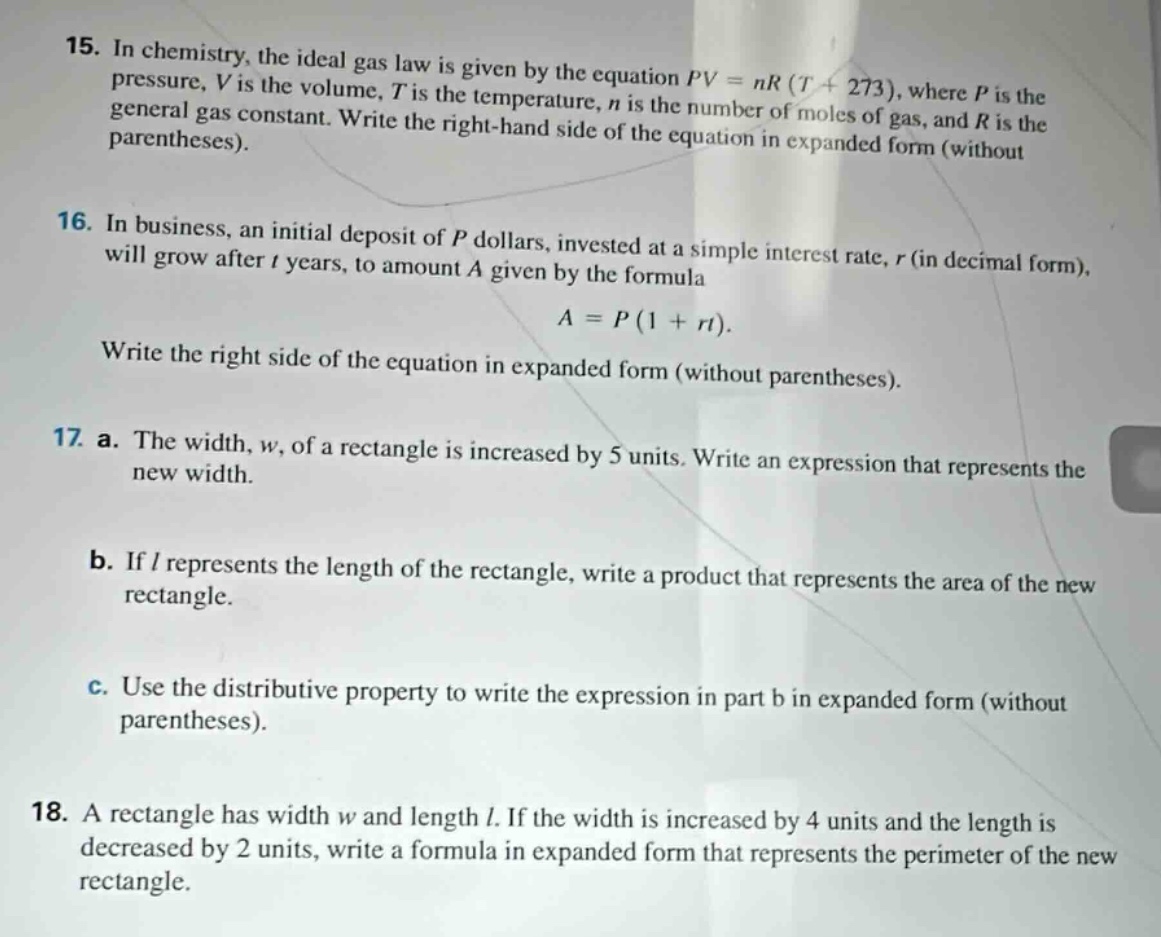
15. in chemistry, the ideal gas law is given by the equation pv = nr(t + 273), where p is the pressure, v is the volume, t is the temperature, n is the number of moles of gas, and r is the general gas constant. write the right - hand side of the equation in expanded form (without parentheses). 16. in business, an initial deposit of p dollars, invested at a simple interest rate, r (in decimal form), will grow after t years, to amount a given by the formula a = p(1 + rt). write the right side of the equation in expanded form (without parentheses). 17. a. the width, w, of a rectangle is increased by 5 units. write an expression that represents the new width. b. if l represents the length of the rectangle, write a product that represents the area of the new rectangle. c. use the distributive property to write the expression in part b in expanded form (without parentheses). 18. a rectangle has width w and length l. if the width is increased by 4 units and the length is decreased by 2 units, write a formula in expanded form that represents the perimeter of the new rectangle.
Answer
Explanation:
Step1: Expand the ideal - gas law
We use the distributive property (a(b + c)=ab+ac). Given (PV=nR(T + 273)), then (nR(T + 273)=nRT+273nR).
Step2: Expand the simple - interest formula
Using the distributive property (a(b + c)=ab + ac) on (A = P(1+rt)), we get (A=P\times1+P\times rt=P + Prt).
Step3: Find the new width of the rectangle
If the original width is (w) and it is increased by 5 units, the new width is (w + 5).
Step4: Find the area of the new rectangle
The length is (l) and the new width is (w + 5), so the area (A=l(w + 5)).
Step5: Expand the area expression
Using the distributive property (a(b + c)=ab+ac) on (l(w + 5)), we get (lw+5l).
Step6: Find the perimeter of the new rectangle
The original width is (w), the new width is (w + 4), the original length is (l), and the new length is (l-2). The perimeter formula of a rectangle is (P = 2(\text{length}+\text{width})). So the perimeter of the new rectangle is (P=2((l - 2)+(w + 4))). First, simplify inside the parentheses: ((l - 2)+(w + 4)=l-2+w + 4=l+w + 2). Then, multiply by 2: (P = 2(l+w + 2)=2l+2w+4).
Answer:
- (nRT + 273nR)
- (P+Prt)
- a. (w + 5) b. (l(w + 5)) c. (lw+5l)
- (2l+2w + 4)