15. consider the following graphs:\n(i) (ii) (iii)\n(iv) (v)\nwhich is the graph of $y = 1 - e^{-x}$?\na)…
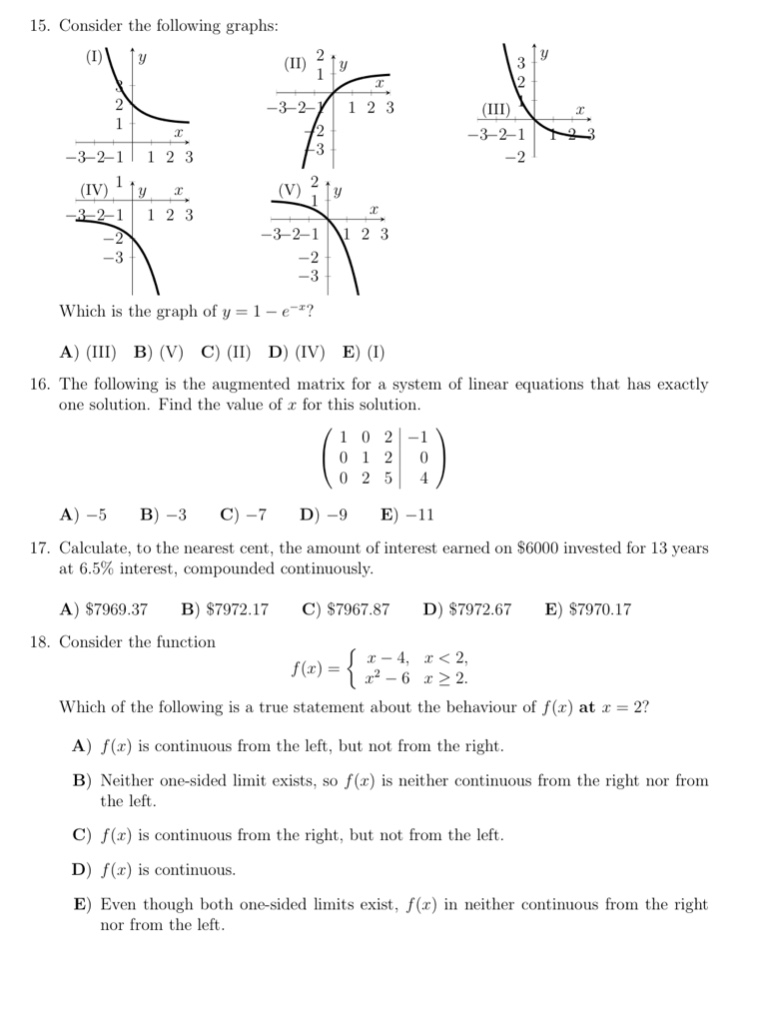
15. consider the following graphs:\n(i) (ii) (iii)\n(iv) (v)\nwhich is the graph of $y = 1 - e^{-x}$?\na) (iii) b) (v) c) (ii) d) (iv) e) (i)\n16. the following is the augmented matrix for a system of linear equations that has exactly one solution. find the value of $x$ for this solution.\n$\\begin{pmatrix}1&0&2& - 1\\\\0&1&2&0\\\\0&2&5&4\\end{pmatrix}$\na) - 5 b) - 3 c) - 7 d) - 9 e) - 11\n17. calculate, to the nearest cent, the amount of interest earned on $6000 invested for 13 years at 6.5% interest, compounded continuously.\na) $7969.37 b) $7972.17 c) $7967.87 d) $7972.67 e) $7970.17\n18. consider the function $f(x)=\\begin{cases}x - 4,x < 2,\\\\x^{2}-6,x\\geq2.\\end{cases}$\nwhich of the following is a true statement about the behaviour of $f(x)$ at $x = 2$?\na) $f(x)$ is continuous from the left, but not from the right.\nb) neither one - sided limit exists, so $f(x)$ is neither continuous from the right nor from the left.\nc) $f(x)$ is continuous from the right, but not from the left.\nd) $f(x)$ is continuous.\ne) even though both one - sided limits exist, $f(x)$ in neither continuous from the right nor from the left.
Answer
15.
Explanation:
Step1: Analyze the function $y = 1 - e^{-x}$
When $x = 0$, $y=1 - e^{0}=1 - 1=0$.
Step2: Analyze the limit as $x\to+\infty$
$\lim_{x\to+\infty}(1 - e^{-x})=1-\lim_{x\to+\infty}e^{-x}=1 - 0 = 1$.
Step3: Analyze the limit as $x\to-\infty$
$\lim_{x\to-\infty}(1 - e^{-x})=-\infty$. The graph of $y = 1 - e^{-x}$ passes through the point $(0,0)$ and approaches $y = 1$ as $x\to+\infty$. Graph (III) satisfies these properties.
Answer:
A. (III)
16.
Explanation:
Step1: Write the system of linear - equations from the augmented matrix
The system of linear equations is $\begin{cases}x + 2z=-1\y + 2z=0\2y+5z = 4\end{cases}$.
Step2: Solve the second and third equations for $y$ and $z$
From $y + 2z=0$, we have $y=-2z$. Substitute $y=-2z$ into $2y + 5z=4$, then $2(-2z)+5z = 4$, which simplifies to $-4z+5z = 4$, so $z = 4$.
Step3: Solve for $x$
Since $z = 4$ and $x+2z=-1$, then $x=-1-2z=-1 - 2\times4=-9$.
Answer:
D. - 9
17.
Explanation:
Step1: Recall the formula for continuous - compounding interest
The formula for continuous - compounding is $A=Pe^{rt}$, where $P$ is the principal amount, $r$ is the annual interest rate (in decimal form), and $t$ is the time in years. The interest earned $I=A - P=P(e^{rt}-1)$.
Step2: Identify the values of $P$, $r$, and $t$
Here, $P = 6000$, $r=0.065$, and $t = 13$.
Step3: Calculate $e^{rt}$
$e^{0.065\times13}=e^{0.845}$. Using a calculator, $e^{0.845}\approx2.328795$.
Step4: Calculate the interest
$I=6000(e^{0.845}-1)=6000\times(2.328795 - 1)=6000\times1.328795=7972.77\approx7972.67$.
Answer:
D. $$7972.67$
18.
Explanation:
Step1: Calculate the left - hand limit
$\lim_{x\to2^{-}}f(x)=\lim_{x\to2^{-}}(x - 4)=2-4=-2$.
Step2: Calculate the right - hand limit
$\lim_{x\to2^{+}}f(x)=\lim_{x\to2^{+}}(x^{2}-6)=2^{2}-6=-2$.
Step3: Calculate $f(2)$
$f(2)=2^{2}-6=-2$. Since $\lim_{x\to2^{-}}f(x)=\lim_{x\to2^{+}}f(x)=f(2)=-2$, the function $f(x)$ is continuous at $x = 2$.
Answer:
D. $f(x)$ is continuous.