2. (a) (15 points) express the following rational function $\frac{2x^{2}+4x + 1}{x^{3}+2x^{2}+x}$ as a sum…
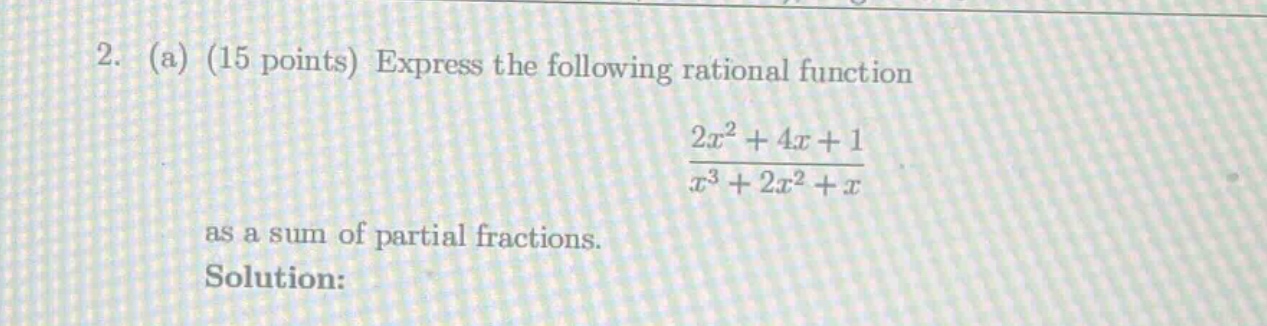
2. (a) (15 points) express the following rational function $\frac{2x^{2}+4x + 1}{x^{3}+2x^{2}+x}$ as a sum of partial fractions. solution:
Answer
Explanation:
Step1: Factor the denominator
First, factor the denominator $x^{3}+2x^{2}+x=x(x^{2}+2x + 1)=x(x + 1)^{2}$.
Step2: Set up the partial - fraction decomposition
We assume $\frac{2x^{2}+4x + 1}{x(x + 1)^{2}}=\frac{A}{x}+\frac{B}{x + 1}+\frac{C}{(x + 1)^{2}}$.
Step3: Clear the fractions
Multiply both sides by $x(x + 1)^{2}$ to get $2x^{2}+4x + 1=A(x + 1)^{2}+Bx(x + 1)+Cx$.
Step4: Find the value of A
Let $x = 0$, then $2\times0^{2}+4\times0 + 1=A(0 + 1)^{2}+B\times0\times(0 + 1)+C\times0$, so $A = 1$.
Step5: Find the value of C
Let $x=-1$, then $2\times(-1)^{2}+4\times(-1)+1=A\times0+B\times0+C\times(-1)$, $2-4 + 1=-C$, so $C = 1$.
Step6: Find the value of B
Expand the right - hand side: $2x^{2}+4x + 1=A(x^{2}+2x + 1)+B(x^{2}+x)+Cx=(A + B)x^{2}+(2A + B + C)x+A$. Since $A = 1$ and $C = 1$, and comparing the coefficients of $x^{2}$: $2=A + B$, substituting $A = 1$ gives $B=1$.
Step7: Write the partial - fraction decomposition
So $\frac{2x^{2}+4x + 1}{x(x + 1)^{2}}=\frac{1}{x}+\frac{1}{x + 1}+\frac{1}{(x + 1)^{2}}$.
Answer:
$\frac{1}{x}+\frac{1}{x + 1}+\frac{1}{(x + 1)^{2}}$