16. what is the speed of a car that travels 150 km in 3 hours? speed = (distance / time) a) 50 km/hr b) 45…
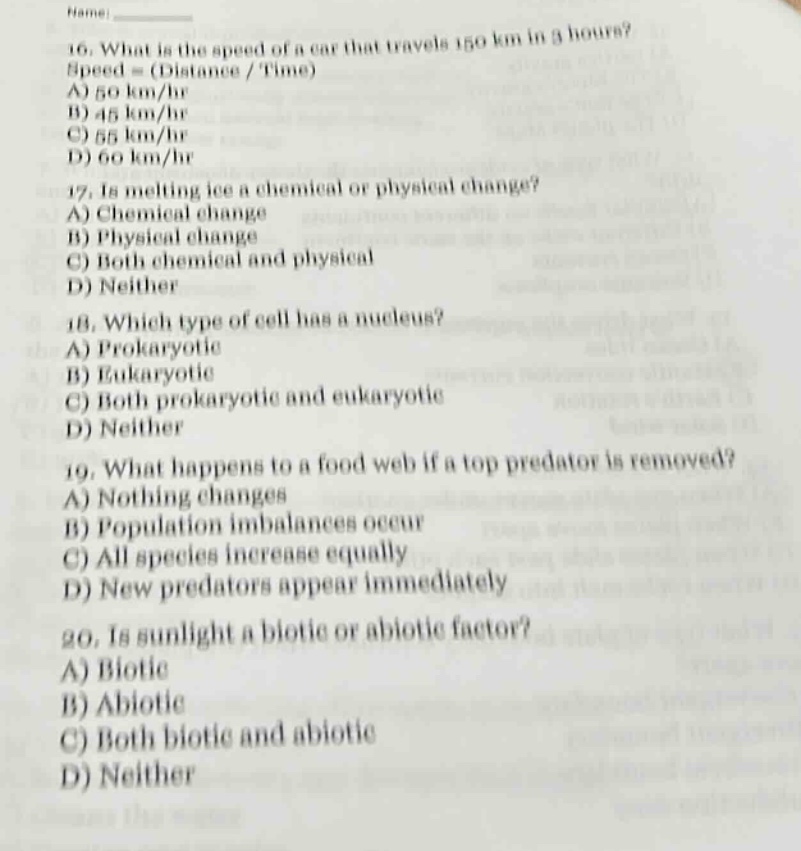
16. what is the speed of a car that travels 150 km in 3 hours? speed = (distance / time) a) 50 km/hr b) 45 km/hr c) 55 km/hr d) 60 km/hr\n17. is melting ice a chemical or physical change? a) chemical change b) physical change c) both chemical and physical d) neither\n18. which type of cell has a nucleus? a) prokaryotic b) eukaryotic c) both prokaryotic and eukaryotic d) neither\n19. what happens to a food web if a top predator is removed? a) nothing changes b) population imbalances occur c) all species increase equally d) new predators appear immediately\n20. is sunlight a biotic or abiotic factor? a) biotic b) abiotic c) both biotic and abiotic d) neither
Answer
Explanation:
Step1: Calculate speed for question 16
Speed = $\frac{Distance}{Time}=\frac{150}{3}=50$ km/hr
Step2: Determine change type for question 17
Melting ice is a physical change as no new substance is formed.
Step3: Identify cell - type for question 18
Eukaryotic cells have a nucleus.
Step4: Analyze food - web change for question 19
Removing a top predator causes population imbalances in the food web.
Step5: Classify sunlight for question 20
Sunlight is an abiotic factor as it is a non - living component.
Answer:
- A. 50 km/hr
- B. Physical change
- B. Eukaryotic
- B. Population imbalances occur
- B. Abiotic