21. in 2011 the population of texas was 25.67 million with a growth rate of 2.06% per year. estimate the…
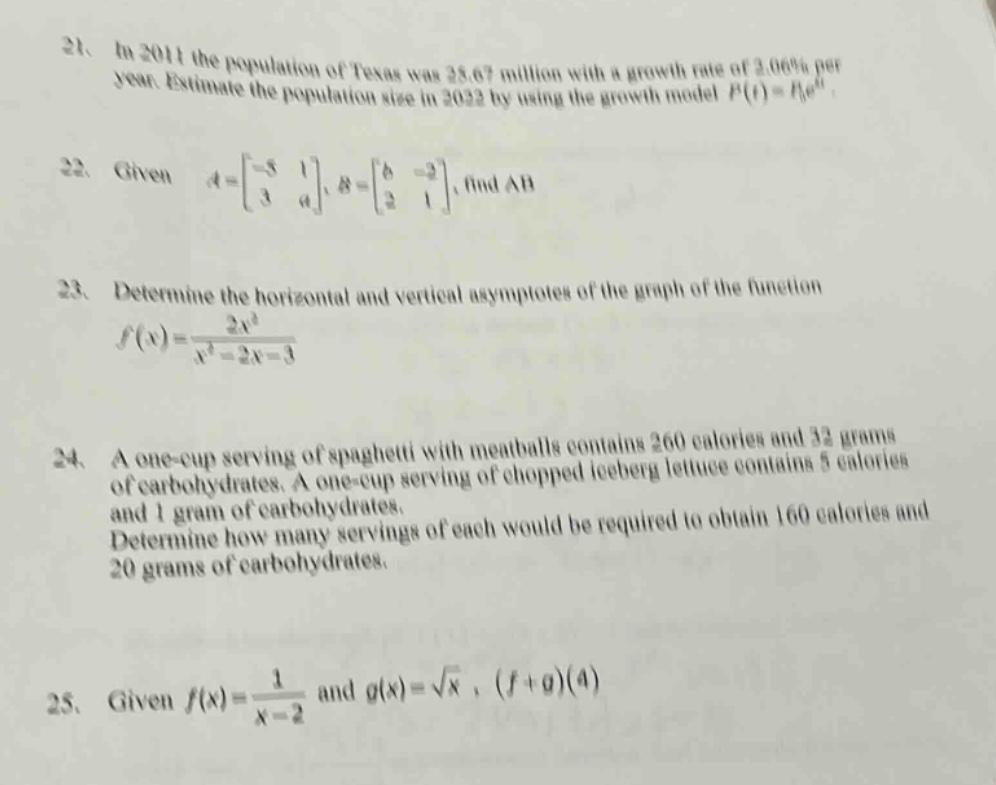
21. in 2011 the population of texas was 25.67 million with a growth rate of 2.06% per year. estimate the population size in 2022 by using the growth model (p(t)=p_0e^{rt}).\n22. given (a = \begin{bmatrix}-5&1\\3&4end{bmatrix}, b=\begin{bmatrix}6& - 2\\2&1end{bmatrix}), find (ab).\n23. determine the horizontal and vertical asymptotes of the graph of the function (f(x)=\frac{2x^{2}}{x^{2}-2x - 3}).\n24. a one - cup serving of spaghetti with meatballs contains 260 calories and 32 grams of carbohydrates. a one - cup serving of chopped iceberg lettuce contains 5 calories and 1 gram of carbohydrates. determine how many servings of each would be required to obtain 160 calories and 20 grams of carbohydrates.\n25. given (f(x)=\frac{1}{x - 2}) and (g(x)=sqrt{x}), ((f + g)(4))
Answer
Question 21
Explanation:
Step1: Identify values for the formula
$P_0 = 25.67$ (initial - population in 2011), $r=0.0206$ (growth rate), $t = 2022 - 2011=11$ (number of years).
Step2: Substitute into the formula $P(t)=P_0e^{rt}$
$P(11)=25.67e^{0.0206\times11}$
Step3: Calculate the exponent
$0.0206\times11 = 0.2266$
Step4: Calculate $e^{0.2266}$
Using a calculator, $e^{0.2266}\approx1.254$
Step5: Calculate the population
$P(11)=25.67\times1.254\approx32.29$ (in million)
Answer:
$32.29$ million
Question 22
Explanation:
Step1: Recall the matrix - multiplication formula
If $A=\left[\begin{array}{cc}a_{11}&a_{12}\a_{21}&a_{22}\end{array}\right]$ and $B = \left[\begin{array}{cc}b_{11}&b_{12}\b_{21}&b_{22}\end{array}\right]$, then $AB=\left[\begin{array}{cc}a_{11}b_{11}+a_{12}b_{21}&a_{11}b_{12}+a_{12}b_{22}\a_{21}b_{11}+a_{22}b_{21}&a_{21}b_{12}+a_{22}b_{22}\end{array}\right]$
Step2: Calculate the elements of $AB$
$AB=\left[\begin{array}{cc}- 5\times6 + 1\times2&-5\times(-3)+1\times1\3\times6 + 4\times2&3\times(-3)+4\times1\end{array}\right]$
Step3: Perform the multi -plications and additions
$AB=\left[\begin{array}{cc}-30 + 2&15 + 1\18+8&-9 + 4\end{array}\right]=\left[\begin{array}{cc}-28&16\26&-5\end{array}\right]$
Answer:
$\left[\begin{array}{cc}-28&16\26&-5\end{array}\right]$
Question 23
Explanation:
Step1: Find the vertical asymptotes
Set the denominator equal to zero: $x^{2}-2x - 3=0$. Factor the quadratic equation: $(x - 3)(x+1)=0$. So $x = 3$ and $x=-1$ are the vertical asymptotes.
Step2: Find the horizontal asymptotes
Since the degree of the numerator $n = 2$ and the degree of the denominator $m = 2$ and the leading - coefficient of the numerator $a = 2$ and the leading - coefficient of the denominator $b = 1$. The horizontal asymptote is $y=\frac{a}{b}=2$.
Answer:
Vertical asymptotes: $x = 3$ and $x=-1$; Horizontal asymptote: $y = 2$
Question 24
Explanation:
Step1: Set up a system of equations
Let $x$ be the number of servings of spaghetti and $y$ be the number of servings of lettuce. The calorie equation is $260x + 5y=160$, and the carbohydrate equation is $32x+1y = 20$.
Step2: Solve the system
From the second equation $y=20 - 32x$. Substitute $y$ into the first equation: $260x+5(20 - 32x)=160$. Expand: $260x + 100-160x=160$. Combine like terms: $100x=60$, so $x = 0.6$. Substitute $x = 0.6$ into $y=20 - 32x$: $y=20-32\times0.6=20 - 19.2 = 0.8$
Answer:
$0.6$ servings of spaghetti and $0.8$ servings of lettuce
Question 25
Explanation:
Step1: Recall the definition of $(f + g)(x)$
$(f + g)(x)=f(x)+g(x)$. So $(f + g)(4)=f(4)+g(4)$.
Step2: Calculate $f(4)$
$f(4)=\frac{1}{4 - 2}=\frac{1}{2}$
Step3: Calculate $g(4)$
$g(4)=\sqrt{4}=2$
Step4: Calculate $(f + g)(4)$
$(f + g)(4)=\frac{1}{2}+2=\frac{1 + 4}{2}=\frac{5}{2}$
Answer:
$\frac{5}{2}$