21) engineering: the maximum load in tons that a foundation column can withstand is represented by the…
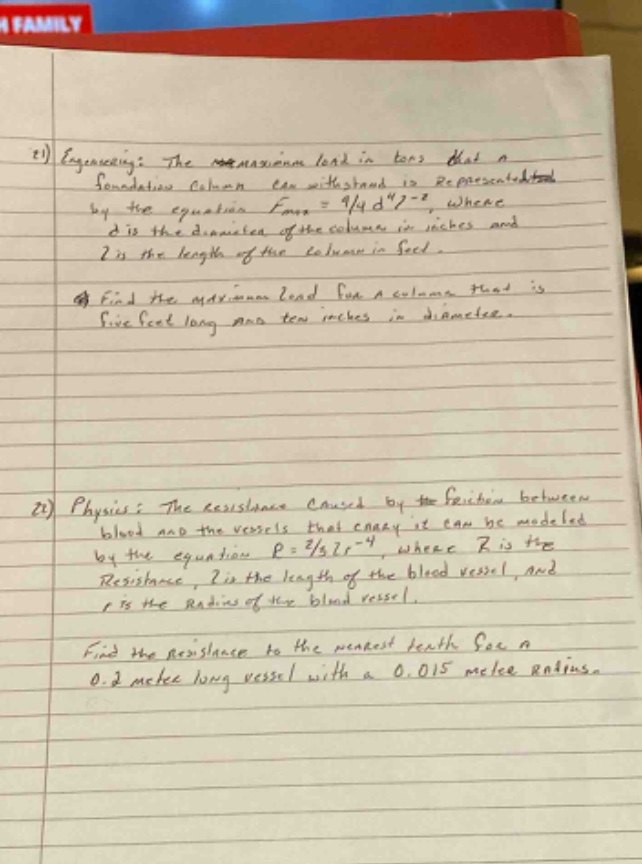
21) engineering: the maximum load in tons that a foundation column can withstand is represented by the equation fmax = 9/4 d^2 / l, where d is the diameter of the column in inches and l is the length of the column in feet. a) find the maximum load for a column that is five feet long and ten inches in diameter. 22) physics: the resistance caused by the friction between blood and the vessels that carry it can be modeled by the equation p = 8/3 l r^-4, where r is the resistance, l is the length of the blood - vessel, and r is the radius of the blood - vessel. find the resistance to the nearest tenth for a 0.2 meter long vessel with a 0.015 meter radius.
Answer
21.
Explanation:
Step1: Identify values
Given $d = 10$ inches and $l=5$ feet.
Step2: Substitute into formula
The formula is $F_{max}=\frac{9}{4}\frac{d^{2}}{l}$. Substitute $d = 10$ and $l = 5$ into it: $F_{max}=\frac{9}{4}\times\frac{10^{2}}{5}$.
Step3: Calculate
First, $10^{2}=100$. Then $\frac{100}{5}=20$. Next, $\frac{9}{4}\times20 = 45$ tons.
Answer:
45 tons
22.
Explanation:
Step1: Identify values
Given $l = 0.2$ meters and $r=0.015$ meters. The formula is $P=\frac{8}{\pi}\frac{l}{r^{4}}$.
Step2: Calculate $r^{4}$
$r^{4}=(0.015)^{4}=0.015\times0.015\times0.015\times0.015 = 5.0625\times10^{-8}$.
Step3: Calculate $\frac{l}{r^{4}}$
$\frac{l}{r^{4}}=\frac{0.2}{5.0625\times 10^{-8}}=\frac{0.2\times10^{8}}{5.0625}=\frac{2\times10^{7}}{5.0625}\approx3.95\times10^{6}$.
Step4: Calculate $P$
$P=\frac{8}{\pi}\times\frac{l}{r^{4}}$. Substitute $\frac{l}{r^{4}}\approx3.95\times10^{6}$: $P=\frac{8}{\pi}\times3.95\times 10^{6}\approx\frac{8\times3.95\times10^{6}}{\pi}\approx1.0\times10^{7}$.
Answer:
$1.0\times10^{7}$