21 a light year is defined as the distance light travels in one year. one light year is 9.46×10¹²…
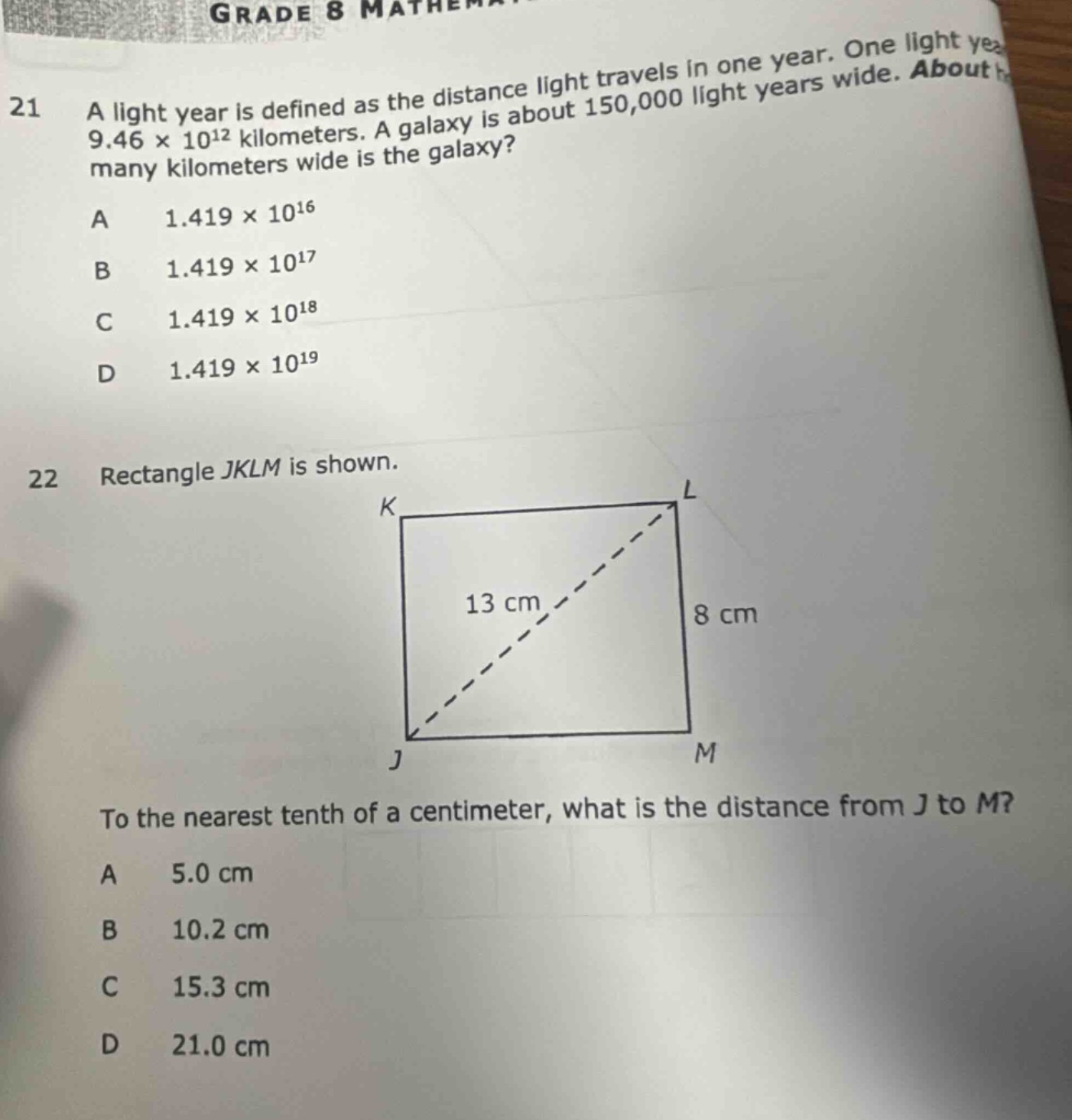
21 a light year is defined as the distance light travels in one year. one light year is 9.46×10¹² kilometers. a galaxy is about 150,000 light years wide. about how many kilometers wide is the galaxy? a 1.419×10¹⁶ b 1.419×10¹⁷ c 1.419×10¹⁸ d 1.419×10¹⁹ 22 rectangle jklm is shown. to the nearest tenth of a centimeter, what is the distance from j to m? a 5.0 cm b 10.2 cm c 15.3 cm d 21.0 cm
Answer
Explanation:
Step1: Calculate width of galaxy
We know that 1 light - year = $9.46\times10^{12}$ kilometers and the galaxy is 150000 light - years wide. First, write 150000 in scientific notation as $1.5\times10^{5}$. Then multiply the distance per light - year by the number of light - years: $(9.46\times10^{12})\times(1.5\times10^{5})$. Using the rule of exponents $a^{m}\times a^{n}=a^{m + n}$ and $(a\times10^{m})\times(b\times10^{n})=(a\times b)\times10^{m + n}$, we have $(9.46\times1.5)\times10^{12 + 5}=14.19\times10^{17}$. Rewrite in proper scientific notation: $1.419\times10^{18}$.
Step2: Calculate distance in rectangle
In rectangle $JKLM$, triangle $JML$ is a right - triangle with hypotenuse $JL = 13$ cm and one side $LM=8$ cm. We want to find $JM$. Using the Pythagorean theorem $a^{2}+b^{2}=c^{2}$, where $c = 13$ and $b = 8$, then $a=\sqrt{c^{2}-b^{2}}$. So $JM=\sqrt{13^{2}-8^{2}}=\sqrt{169 - 64}=\sqrt{105}\approx10.2$ cm.
Answer:
- C. $1.419\times10^{18}$
- B. $10.2$ cm