4/25/25\n7. find the determinant of the matrix $\begin{bmatrix}1&1\\ - 3&4end{bmatrix}$\n8. find the…
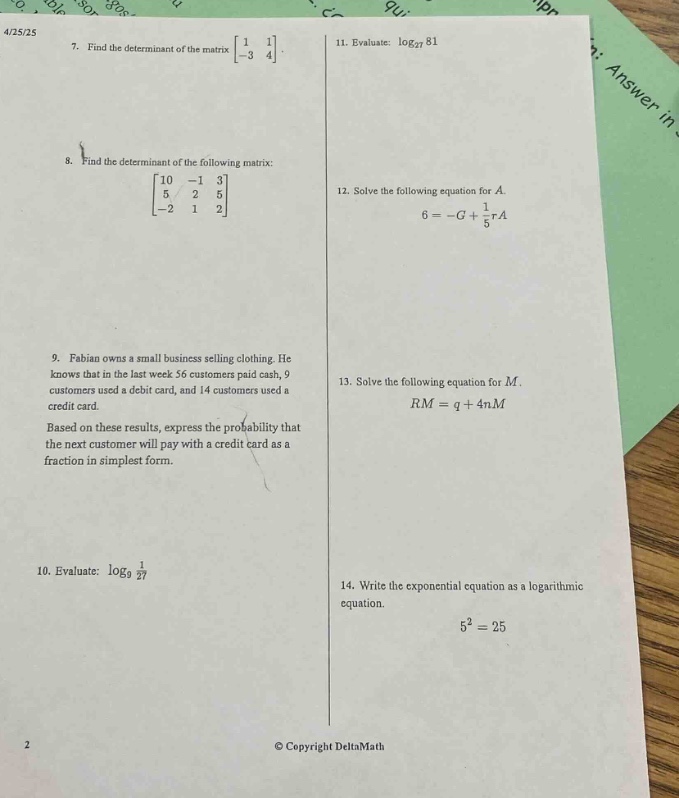
4/25/25\n7. find the determinant of the matrix $\begin{bmatrix}1&1\\ - 3&4end{bmatrix}$\n8. find the determinant of the following matrix: $\begin{bmatrix}10&-1&3\\5&2&5\\ - 2&1&2end{bmatrix}$\n9. fabian owns a small business selling clothing. he knows that in the last week 56 customers paid cash, 9 customers used a debit card, and 14 customers used a credit card. based on these results, express the probability that the next customer will pay with a credit card as a fraction in simplest form.\n10. evaluate: $log_{9}\frac{1}{27}$\n11. evaluate: $log_{27}81$\n12. solve the following equation for $a$. $6=-g+\frac{1}{5}a$\n13. solve the following equation for $m$. $rm = q + 4nm$\n14. write the exponential equation as a logarithmic equation. $5^{2}=25$\n© copyright deltamath
Answer
7. Find the determinant of the matrix $\begin{bmatrix}1&1\ - 3&4\end{bmatrix}$
Explanation:
Step1: Recall determinant formula
For a $2\times2$ matrix $\begin{bmatrix}a&b\c&d\end{bmatrix}$, the determinant is $ad - bc$. Here $a = 1$, $b = 1$, $c=-3$, $d = 4$. $1\times4-1\times(-3)$
Step2: Calculate the result
$4 + 3=7$
Answer:
$7$
8. Find the determinant of the matrix $\begin{bmatrix}10&-1&3\5&2&5\-2&1&2\end{bmatrix}$
Explanation:
Step1: Expand the determinant
[ \begin{align*} &10\times\begin{vmatrix}2&5\1&2\end{vmatrix}-(-1)\times\begin{vmatrix}5&5\-2&2\end{vmatrix}+3\times\begin{vmatrix}5&2\-2&1\end{vmatrix}\ \end{align*} ]
Step2: Calculate $2\times2$ determinants
For $\begin{vmatrix}2&5\1&2\end{vmatrix}=2\times2 - 5\times1=4 - 5=-1$; for $\begin{vmatrix}5&5\-2&2\end{vmatrix}=5\times2-5\times(-2)=10 + 10 = 20$; for $\begin{vmatrix}5&2\-2&1\end{vmatrix}=5\times1-2\times(-2)=5 + 4 = 9$. [ \begin{align*} &10\times(-1)+1\times20 + 3\times9\ &=-10+20 + 27\ &=37 \end{align*} ]
Answer:
$37$
9. Fabian owns a small - business selling clothing. He knows that in the last week 56 customers paid cash, 9 customers used a debit card, and 14 customers used a credit card. Based on these results, express the probability that the next customer will pay with a credit card as a fraction in simplest form.
Explanation:
Step1: Find total number of customers
The total number of customers is $56 + 9+14=79$.
Step2: Calculate probability
The probability $P$ that the next customer will pay with a credit card is the number of credit - card users divided by the total number of customers. So $P=\frac{14}{79}$.
Answer:
$\frac{14}{79}$
10. Evaluate $\log_{9}\frac{1}{27}$
Explanation:
Step1: Let $\log_{9}\frac{1}{27}=x$, then rewrite in exponential form
$9^{x}=\frac{1}{27}$. Since $9 = 3^{2}$ and $27=3^{3}$, we have $(3^{2})^{x}=3^{- 3}$.
Step2: Simplify the left - hand side
Using the power - of - a - power rule $(a^{m})^{n}=a^{mn}$, we get $3^{2x}=3^{-3}$.
Step3: Solve for $x$
Since the bases are the same, $2x=-3$, so $x =-\frac{3}{2}$.
Answer:
$-\frac{3}{2}$
11. Evaluate $\log_{27}81$
Explanation:
Step1: Let $\log_{27}81 = x$, then rewrite in exponential form
$27^{x}=81$. Since $27 = 3^{3}$ and $81 = 3^{4}$, we have $(3^{3})^{x}=3^{4}$.
Step2: Simplify the left - hand side
Using the power - of - a - power rule $(a^{m})^{n}=a^{mn}$, we get $3^{3x}=3^{4}$.
Step3: Solve for $x$
Since the bases are the same, $3x = 4$, so $x=\frac{4}{3}$.
Answer:
$\frac{4}{3}$
12. Solve the following equation for $A$: $6=-G+\frac{1}{5}A$
Explanation:
Step1: Isolate the term with $A$
Add $G$ to both sides of the equation: $6 + G=\frac{1}{5}A$.
Step2: Solve for $A$
Multiply both sides by $5$: $A = 5(6 + G)=30+5G$.
Answer:
$A = 30 + 5G$
13. Solve the following equation for $M$: $RM=q + 4nM$
Explanation:
Step1: Move terms with $M$ to one side
$RM-4nM=q$.
Step2: Factor out $M$
$M(R - 4n)=q$.
Step3: Solve for $M$
$M=\frac{q}{R - 4n}$ (assuming $R\neq4n$).
Answer:
$M=\frac{q}{R - 4n}$
14. Write the exponential equation $5^{2}=25$ as a logarithmic equation.
Explanation:
Step1: Recall the conversion rule
If $a^{b}=c$, then $\log_{a}c=b$. Here $a = 5$, $b = 2$, $c = 25$. $\log_{5}25=2$
Answer:
$\log_{5}25=2$