25 solve for x: 1/x - 1/3 = -1/3x\n26 describe how a controlled experiment can be created to examine the…
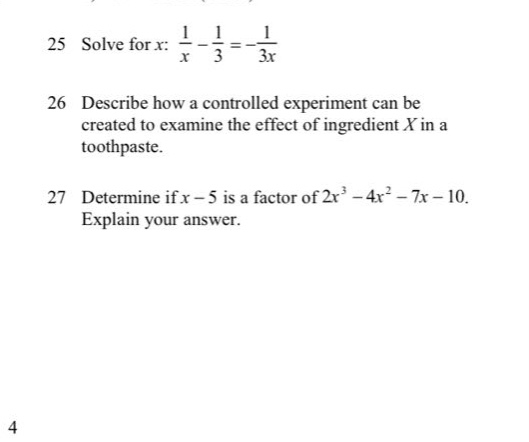
25 solve for x: 1/x - 1/3 = -1/3x\n26 describe how a controlled experiment can be created to examine the effect of ingredient x in a toothpaste.\n27 determine if x - 5 is a factor of 2x³ - 4x² - 7x - 10. explain your answer.
Answer
25
Explanation:
Step1: Find a common - denominator
The common denominator of (x), (3), and (3x) is (3x). Multiply each term by (3x): (3x\times\frac{1}{x}-3x\times\frac{1}{3}=3x\times(-\frac{1}{3x}))
Step2: Simplify each term
(3 - x=- 1)
Step3: Solve for (x)
Add (x) to both sides: (3=-1 + x). Then add (1) to both sides: (x = 4)
Answer:
(x = 4)
26
Brief Explanations:
A controlled experiment to examine the effect of ingredient (X) in toothpaste would involve dividing participants into two groups - an experimental group that uses toothpaste with ingredient (X) and a control group that uses toothpaste without ingredient (X). Keep other factors like brushing frequency, diet, and oral - hygiene habits as consistent as possible among participants. Measure outcomes such as tooth decay, gum health, or tooth sensitivity over a set period.
Answer:
Divide participants into two groups (experimental with ingredient (X) and control without it), keep other factors constant, and measure relevant oral - health outcomes over time.
27
Explanation:
Step1: Use the factor theorem
According to the factor theorem, if (x - a) is a factor of a polynomial (P(x)), then (P(a)=0). Here (a = 5) and (P(x)=2x^{3}-4x^{2}-7x - 10).
Step2: Calculate (P(5))
(P(5)=2\times5^{3}-4\times5^{2}-7\times5 - 10) (=2\times125-4\times25-35 - 10) (=250-100 - 35 - 10) (=105\neq0)
Answer:
(x - 5) is not a factor of (2x^{3}-4x^{2}-7x - 10) because (P(5)=105\neq0) according to the factor theorem.