m∠6 is (2x - 5)° and m∠8 is (x + 5)°. what is m∠3?
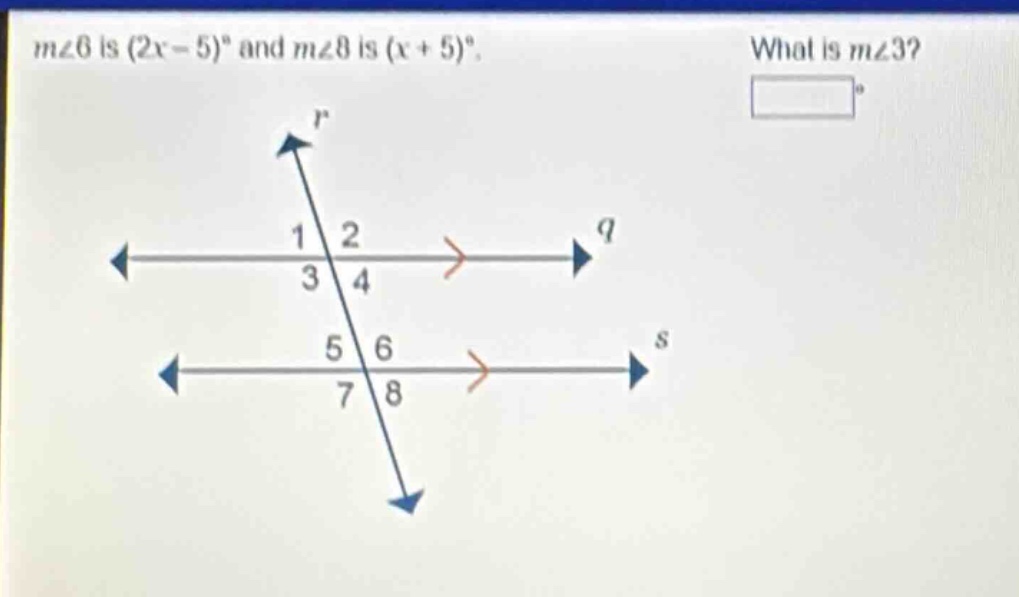
m∠6 is (2x - 5)° and m∠8 is (x + 5)°. what is m∠3?
Answer
Explanation:
Step1: Use vertical - angle property
Since $\angle6$ and $\angle8$ are vertical angles, $m\angle6 = m\angle8$. So, $2x−5=x + 5$.
Step2: Solve for $x$
Subtract $x$ from both sides: $2x−x−5=x−x + 5$, which gives $x−5 = 5$. Then add 5 to both sides: $x=10$.
Step3: Find $m\angle6$
Substitute $x = 10$ into the expression for $m\angle6$: $m\angle6=2x−5=2\times10−5=15^{\circ}$.
Step4: Use corresponding - angle property
$\angle6$ and $\angle2$ are corresponding angles. So, $m\angle2=m\angle6 = 15^{\circ}$.
Step5: Use linear - pair property
$\angle2$ and $\angle3$ form a linear - pair. Since $\angle2+\angle3 = 180^{\circ}$, then $m\angle3=180 - m\angle2$.
Step6: Calculate $m\angle3$
$m\angle3=180 - 15=165^{\circ}$.
Answer:
$165$