if $p(x)=2x^{2}-4x$ and $q(x)=x - 3$, what is $(pcirc q)(x)$?\n$2x^{2}-4x + 12$\n$2x^{2}-16x +…
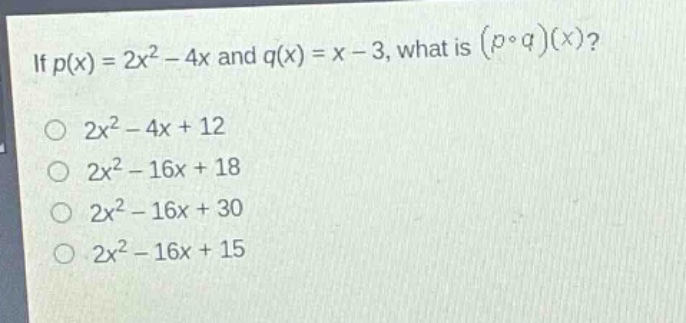
if $p(x)=2x^{2}-4x$ and $q(x)=x - 3$, what is $(pcirc q)(x)$?\n$2x^{2}-4x + 12$\n$2x^{2}-16x + 18$\n$2x^{2}-16x + 30$\n$2x^{2}-16x + 15$
Answer
Answer:
C. $2x^{2}-16x + 30$
Explanation:
Step1: Recall composition formula
$(p\circ q)(x)=p(q(x))$
Step2: Substitute $q(x)$ into $p(x)$
Since $p(x)=2x^{2}-4x$ and $q(x)=x - 3$, then $p(q(x))=2(q(x))^{2}-4(q(x))$. Replace $q(x)$ with $x - 3$: $2(x - 3)^{2}-4(x - 3)$.
Step3: Expand $(x - 3)^{2}$
Using $(a - b)^{2}=a^{2}-2ab + b^{2}$, where $a=x$ and $b = 3$, we get $(x - 3)^{2}=x^{2}-6x + 9$. So $2(x - 3)^{2}-4(x - 3)=2(x^{2}-6x + 9)-4(x - 3)$.
Step4: Distribute the coefficients
$2(x^{2}-6x + 9)-4(x - 3)=2x^{2}-12x+18-4x + 12$.
Step5: Combine like - terms
$2x^{2}-12x-4x+18 + 12=2x^{2}-16x + 30$.