30 a baker is making cakes. it takes 9 eggs to make each cake. the baker has 8 cartons of eggs, and each…
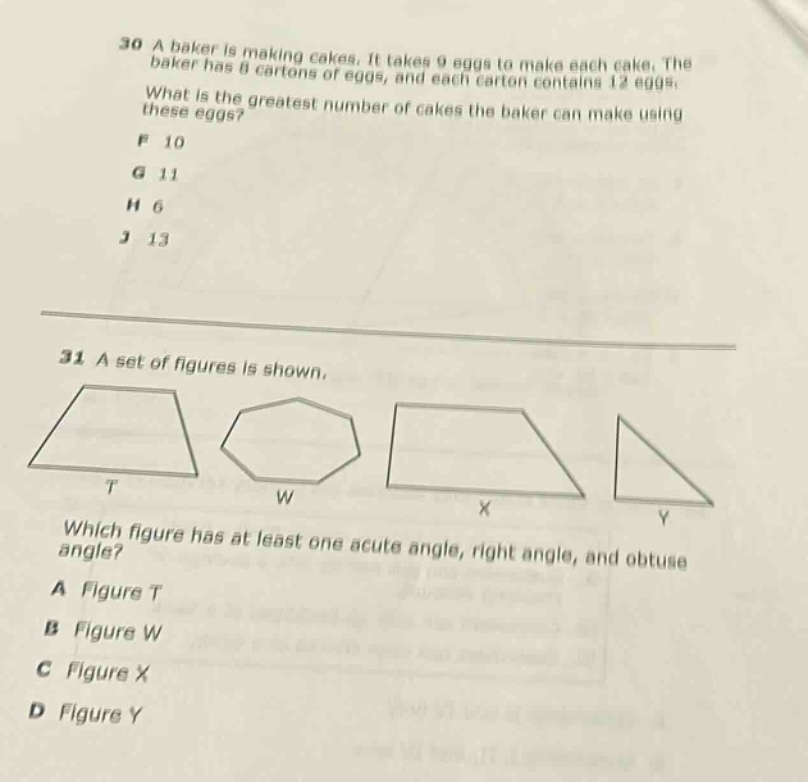
30 a baker is making cakes. it takes 9 eggs to make each cake. the baker has 8 cartons of eggs, and each carton contains 12 eggs. what is the greatest number of cakes the baker can make using these eggs? f 10 g 11 h 6 j 13 31 a set of figures is shown. which figure has at least one acute angle, right angle, and obtuse angle? a figure t b figure w c figure x d figure y
Answer
30.
Explanation:
Step1: Calculate total eggs
The baker has 8 cartons and each carton has 12 eggs. So the total number of eggs is $8\times12 = 96$ eggs.
Step2: Calculate number of cakes
It takes 9 eggs to make one - cake. To find the number of cakes, we divide the total number of eggs by the number of eggs per cake. So the number of cakes is $\lfloor\frac{96}{9}\rfloor=\lfloor10.67\rfloor = 10$ (we take the floor value since we can't make a fraction of a cake).
Answer:
F. 10
31.
Brief Explanations:
- Figure T: It is a trapezoid. It has obtuse and acute angles, but no right - angles.
- Figure W: It is a regular octagon. All its interior angles are obtuse ($135^{\circ}$), and it has no acute or right - angles.
- Figure X: It is a trapezoid - like figure with a right - angle, an obtuse - angle, and an acute - angle.
- Figure Y: It is a right - triangle. It has a right - angle and two acute - angles, but no obtuse - angles.
Answer:
C. Figure X