34. the vertices of △pqr are given in the standard (x,y) coordinate plane below. what is the area, in square…
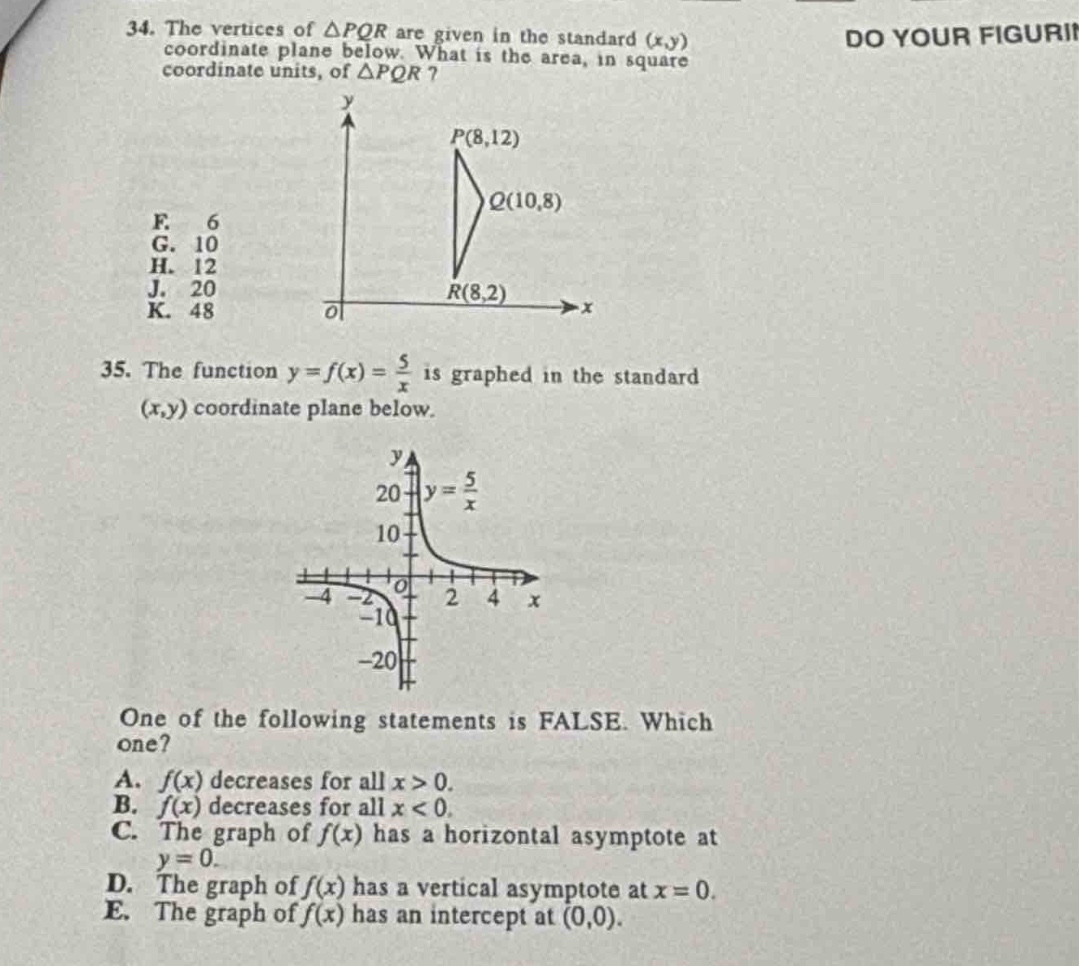
34. the vertices of △pqr are given in the standard (x,y) coordinate plane below. what is the area, in square coordinate units, of △pqr? f. 6 g. 10 h. 12 j. 20 k. 48 35. the function y = f(x)=\frac{5}{x} is graphed in the standard (x,y) coordinate plane below. one of the following statements is false. which one? a. f(x) decreases for all x > 0. b. f(x) decreases for all x < 0. c. the graph of f(x) has a horizontal asymptote at y = 0. d. the graph of f(x) has a vertical asymptote at x = 0. e. the graph of f(x) has an intercept at (0,0).
Answer
34.
Explanation:
Step1: Identify base and height
The points $P(8,12)$ and $R(8,2)$ have the same $x -$coordinate. The distance between them is the height of the triangle. The points $R(8,2)$ and $Q(10,8)$ are used to find the base - like length. The height $h$ between $P(8,12)$ and $R(8,2)$ is calculated as $h=\vert12 - 2\vert=10$. The base $b$ can be found using the distance formula between $R(8,2)$ and $Q(10,8)$. First, find the change in $x$ and $y$: $\Delta x=10 - 8 = 2$ and $\Delta y=8 - 2=6$. But we can also use the formula for the area of a triangle given the coordinates. Another way is to consider the fact that we can use the formula $A=\frac{1}{2}\times base\times height$. The base $b$ (the horizontal distance from the vertical line through $P$ and $R$ to the point $Q$) is $2$ (the difference in $x$ - coordinates of $Q$ and the $x$ - coordinate of $P$ and $R$), and the height $h$ (the vertical distance between $P$ and $R$) is $10$.
Step2: Calculate area
Using the formula $A=\frac{1}{2}\times b\times h$, where $b = 2$ and $h=10$, we have $A=\frac{1}{2}\times2\times10 = 10$.
Answer:
G. 10
35.
Explanation:
- Option A: For $y = f(x)=\frac{5}{x}$, when $x>0$, as $x$ increases, $y$ decreases. For example, if $x = 1,y = 5$; if $x=2,y=\frac{5}{2}$. So $f(x)$ decreases for all $x > 0$.
- Option B: When $x<0$, as $x$ (negative values) increases (e.g., from $x=-2$ to $x = - 1$), $y=\frac{5}{x}$ also decreases. If $x=-2,y=-\frac{5}{2}$; if $x=-1,y=-5$.
- Option C: As $x\rightarrow\pm\infty$, $y=\frac{5}{x}\rightarrow0$. So the graph of $y = f(x)$ has a horizontal asymptote at $y = 0$.
- Option D: The function $y=\frac{5}{x}$ is undefined at $x = 0$. As $x\rightarrow0^{+},y\rightarrow+\infty$ and as $x\rightarrow0^{-},y\rightarrow-\infty$. So the graph has a vertical asymptote at $x = 0$.
- Option E: To find the $x$ - intercept, set $y = 0$. Then $0=\frac{5}{x}$, which has no solution. To find the $y$ - intercept, set $x = 0$, but the function is undefined at $x = 0$. So the graph of $f(x)$ does not have an intercept at $(0,0)$.
Answer:
E. The graph of $f(x)$ has an intercept at $(0,0)$.