y > -3x + 3\ny ≥ 2x - 2\n(1,0)\n(-1,1)\n(2,2)\n(0,3)
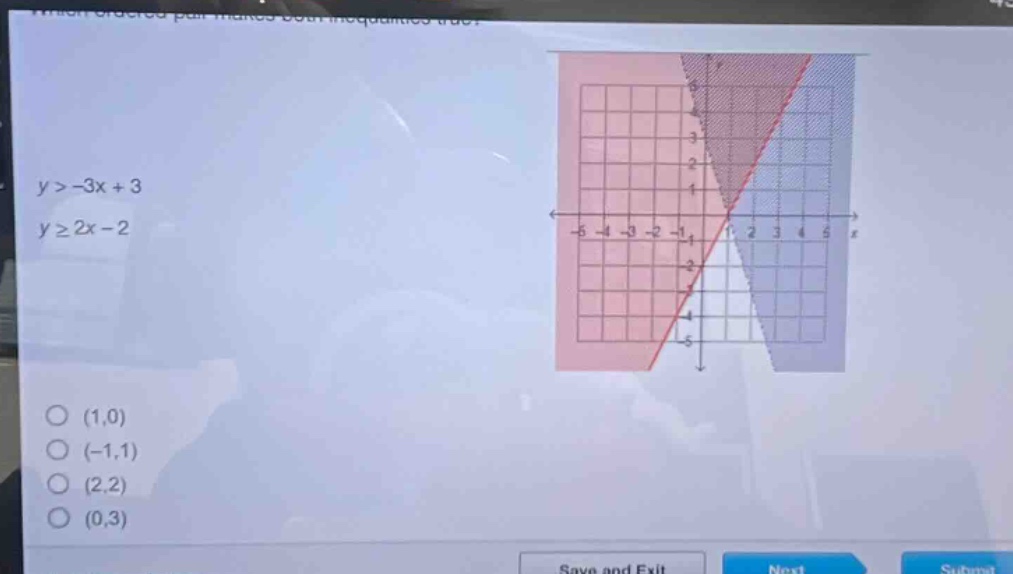
y > -3x + 3\ny ≥ 2x - 2\n(1,0)\n(-1,1)\n(2,2)\n(0,3)
Answer
Explanation:
Step1: Check point (1,0)
For $y > - 3x+3$, substitute $x = 1,y = 0$: $0>-3\times1 + 3=0$, false. For $y\geq2x - 2$, substitute $x = 1,y = 0$: $0\geq2\times1-2 = 0$, true. Since one - inequality is false, (1,0) is not a solution.
Step2: Check point (-1,1)
For $y > - 3x+3$, substitute $x=-1,y = 1$: $1>-3\times(-1)+3=6$, false. For $y\geq2x - 2$, substitute $x=-1,y = 1$: $1\geq2\times(-1)-2=-4$, true. Since one - inequality is false, (-1,1) is not a solution.
Step3: Check point (2,2)
For $y > - 3x+3$, substitute $x = 2,y = 2$: $2>-3\times2+3=-3$, true. For $y\geq2x - 2$, substitute $x = 2,y = 2$: $2\geq2\times2-2 = 2$, true. Since both inequalities are true, (2,2) is a solution.
Step4: Check point (0,3)
For $y > - 3x+3$, substitute $x = 0,y = 3$: $3>-3\times0+3 = 3$, false. For $y\geq2x - 2$, substitute $x = 0,y = 3$: $3\geq2\times0-2=-2$, true. Since one - inequality is false, (0,3) is not a solution.
Answer:
(2,2)