if (f(x)=3x) and (g(x)=\frac{1}{3}x), which expression could be used to verify that (g(x)) is the inverse of…
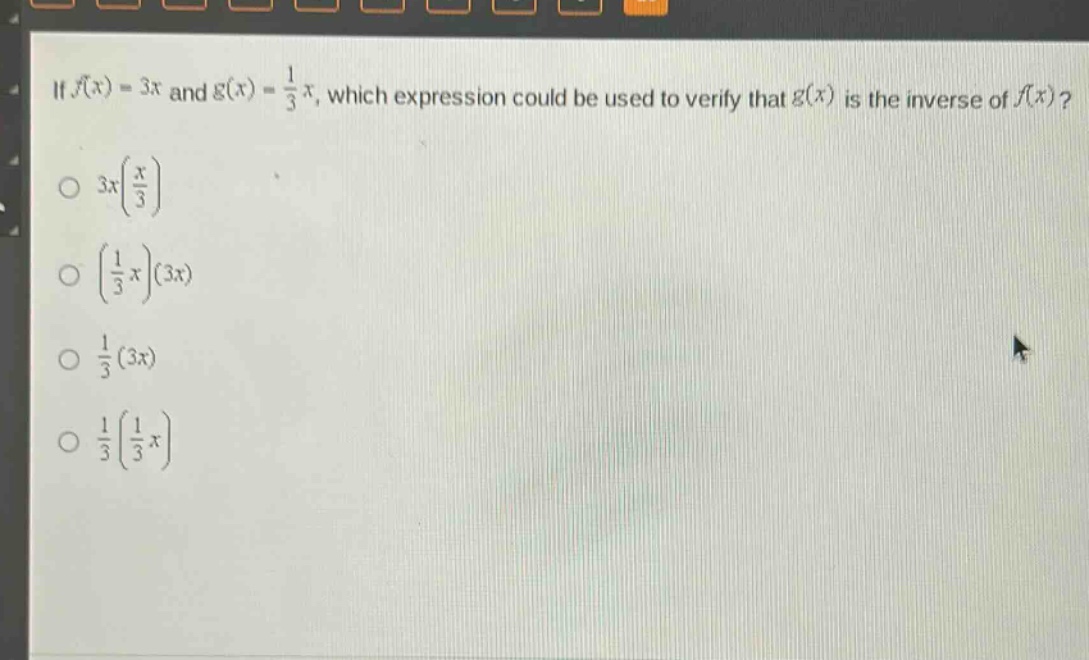
if (f(x)=3x) and (g(x)=\frac{1}{3}x), which expression could be used to verify that (g(x)) is the inverse of (f(x))?\n(3x(\frac{x}{3}))\n((\frac{1}{3}x)(3x))\n(\frac{1}{3}(3x))\n(\frac{1}{3}(\frac{1}{3}x))
Answer
Explanation:
Step1: Recall inverse - function property
If (g(x)) is the inverse of (f(x)), then (f(g(x))=x) and (g(f(x)) = x). Given (f(x)=3x) and (g(x)=\frac{1}{3}x), we find (f(g(x))).
Step2: Substitute (g(x)) into (f(x))
Substitute (x) in (f(x)) with (g(x)=\frac{1}{3}x). So (f(g(x))=3\times(\frac{1}{3}x)).
Answer:
C. (\frac{1}{3}(3x))