9-46 sketch an example of each type of graph described below: a. linear and decreasing b. non - linear and…
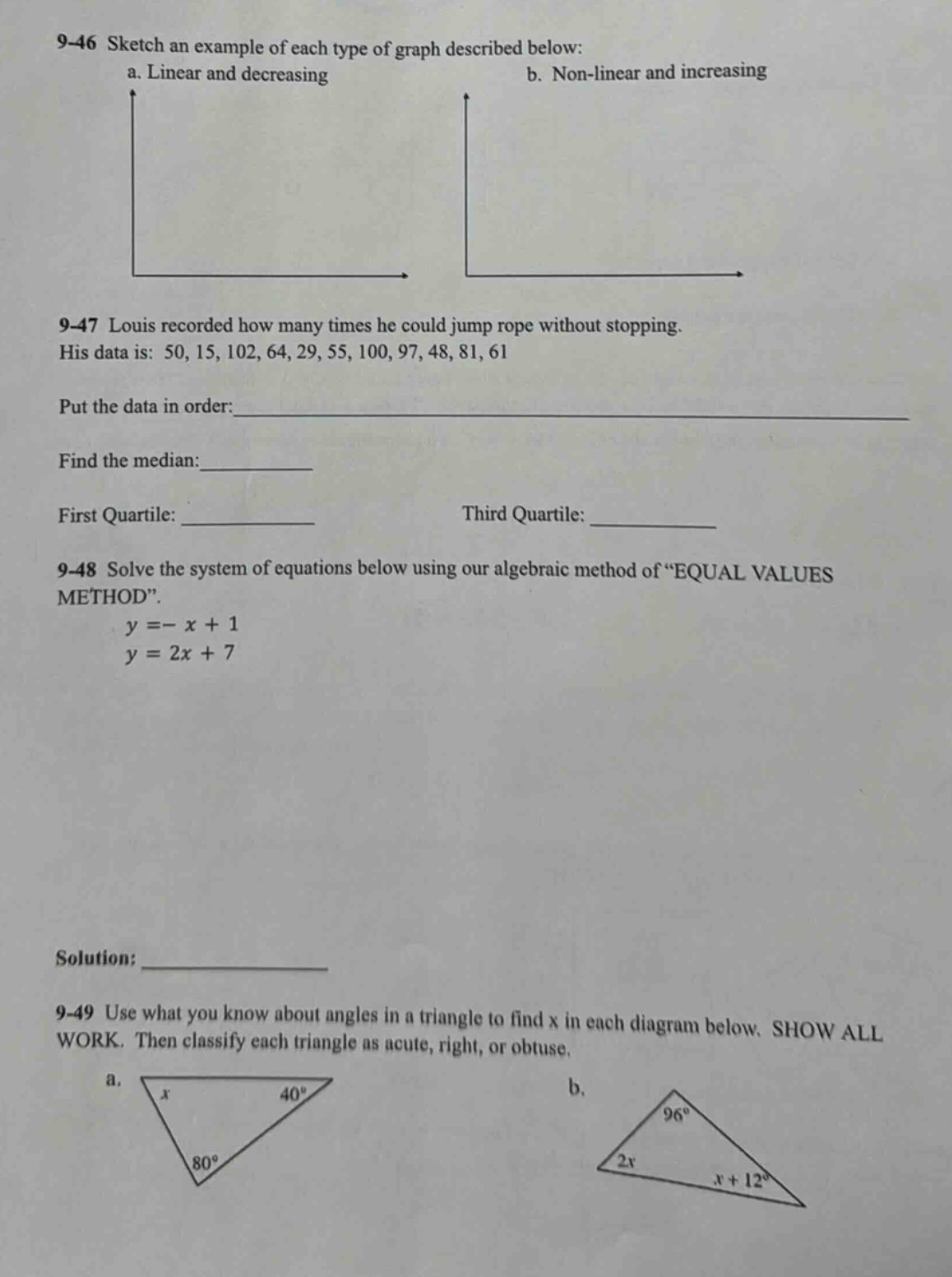
9-46 sketch an example of each type of graph described below: a. linear and decreasing b. non - linear and increasing 9-47 louis recorded how many times he could jump rope without stopping. his data is: 50, 15, 102, 64, 29, 55, 100, 97, 48, 81, 61 put the data in order:____ find the median:____ first quartile:____ third quartile:____ 9-48 solve the system of equations below using our algebraic method of \equal values method\. y = - x + 1 y = 2x + 7 solution:____ 9-49 use what you know about angles in a triangle to find x in each diagram below. show all work. then classify each triangle as acute, right, or obtuse. a. x 40° 80° b. 96° 2x x + 12°
Answer
9 - 46
a. A linear and decreasing graph can be represented by the equation (y=-x). To sketch it, we can plot two - points. When (x = 0), (y=0); when (x = 1), (y=-1). Then draw a straight line through these points. b. A non - linear and increasing graph can be represented by the equation (y = x^{2}) for (x\geq0). We can plot points: when (x = 0), (y = 0); when (x=1), (y = 1); when (x = 2), (y=4) and then draw a smooth curve through these points.
9 - 47
Explanation:
Step1: Order the data
Arrange the data (15,29,48,50,55,61,64,81,97,100,102)
Step2: Find the median
Since there are (n = 11) data points, the median is the (\left(\frac{n + 1}{2}\right))-th value. (\frac{11+1}{2}=6) - th value. So the median is (61).
Step3: Find the first quartile
The lower half of the data is (15,29,48,50,55). Since there are (n_1=5) data points, the first quartile (Q_1) is the (\left(\frac{5 + 1}{2}\right))-th value. So (Q_1 = 48).
Step4: Find the third quartile
The upper half of the data is (64,81,97,100,102). Since there are (n_2 = 5) data points, the third quartile (Q_3) is the (\left(\frac{5+1}{2}\right))-th value. So (Q_3=97).
Answer:
Put the data in order: (15,29,48,50,55,61,64,81,97,100,102) Find the median: (61) First Quartile: (48) Third Quartile: (97)
9 - 48
Explanation:
Step1: Set the two equations equal
Since (y=-x + 1) and (y=2x+7), we set (-x + 1=2x+7).
Step2: Solve for (x)
Add (x) to both sides: (1=3x + 7). Then subtract (7) from both sides: (3x=1 - 7=-6). Divide both sides by (3), we get (x=-2).
Step3: Solve for (y)
Substitute (x=-2) into (y=-x + 1), then (y=-(-2)+1=3).
Answer:
Solution: (x=-2,y = 3)
9 - 49
a.
Explanation:
Step1: Use the angle - sum property of a triangle
The sum of the interior angles of a triangle is (180^{\circ}). So (x+40^{\circ}+80^{\circ}=180^{\circ}).
Step2: Solve for (x)
(x=180-(40 + 80)=60^{\circ}). Since all angles (40^{\circ},60^{\circ},80^{\circ}) are less than (90^{\circ}), the triangle is acute.
Answer:
(x = 60^{\circ}), Acute triangle
b.
Explanation:
Step1: Use the angle - sum property of a triangle
(2x+(x + 12)+96=180).
Step2: Combine like terms
(3x+108 = 180).
Step3: Solve for (x)
Subtract (108) from both sides: (3x=180 - 108 = 72). Divide both sides by (3), (x = 24). The angles are (2x=48^{\circ}), (x + 12=36^{\circ}) and (96^{\circ}). Since one angle (96^{\circ}>90^{\circ}), the triangle is obtuse.
Answer:
(x = 24^{\circ}), Obtuse triangle