4x² is the gcf of this polynomial. 20x²y + 56x³ - ? which could be the mystery term? 22x³ 24x²y 26x²y 28y³
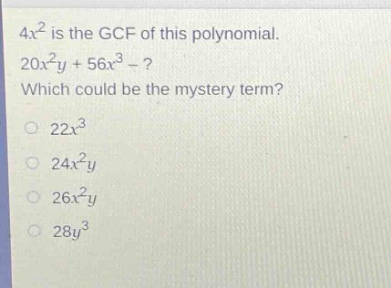
4x² is the gcf of this polynomial. 20x²y + 56x³ - ? which could be the mystery term? 22x³ 24x²y 26x²y 28y³
Answer
Explanation:
Step1: Recall GCF concept
The greatest - common factor (GCF) of a polynomial's terms contains the highest - power common factor of the coefficients and the variables. Given that the GCF of the polynomial is (4x^{2}).
Step2: Analyze each option
Option 1: For (22x^{3})
The GCF of (20x^{2}y), (56x^{3}) and (22x^{3}): The coefficient of (20x^{2}y) is (20 = 2^{2}\times5), the coefficient of (56x^{3}) is (56=2^{3}\times7), and the coefficient of (22x^{3}) is (22 = 2\times11). The GCF of (20), (56) and (22) is (2), not (4). So (22x^{3}) is not correct.
Option 2: For (24x^{2}y)
The coefficient of (20x^{2}y) is (20 = 2^{2}\times5), the coefficient of (56x^{3}) is (56 = 2^{3}\times7), and the coefficient of (24x^{2}y) is (24=2^{3}\times3). The GCF of (20), (56) and (24) is (4). And each term (20x^{2}y), (56x^{3}), (24x^{2}y) has (x^{2}) as the highest - power of (x) common to all of them. So (4x^{2}) is the GCF of (20x^{2}y), (56x^{3}) and (24x^{2}y).
Option 3: For (26x^{2}y)
The coefficient of (20x^{2}y) is (20 = 2^{2}\times5), the coefficient of (56x^{3}) is (56 = 2^{3}\times7), and the coefficient of (26x^{2}y) is (26=2\times13). The GCF of (20), (56) and (26) is (2), not (4). So (26x^{2}y) is not correct.
Option 4: For (28y^{3})
The term (28y^{3}) does not have (x) in it. Since the GCF is (4x^{2}), and (28y^{3}) has no (x) factor, (4x^{2}) cannot be the GCF of (20x^{2}y), (56x^{3}) and (28y^{3}).
Answer:
(24x^{2}y)