55. which of the following represents two dependent events? a. drawing a card from a deck, not replacing it…
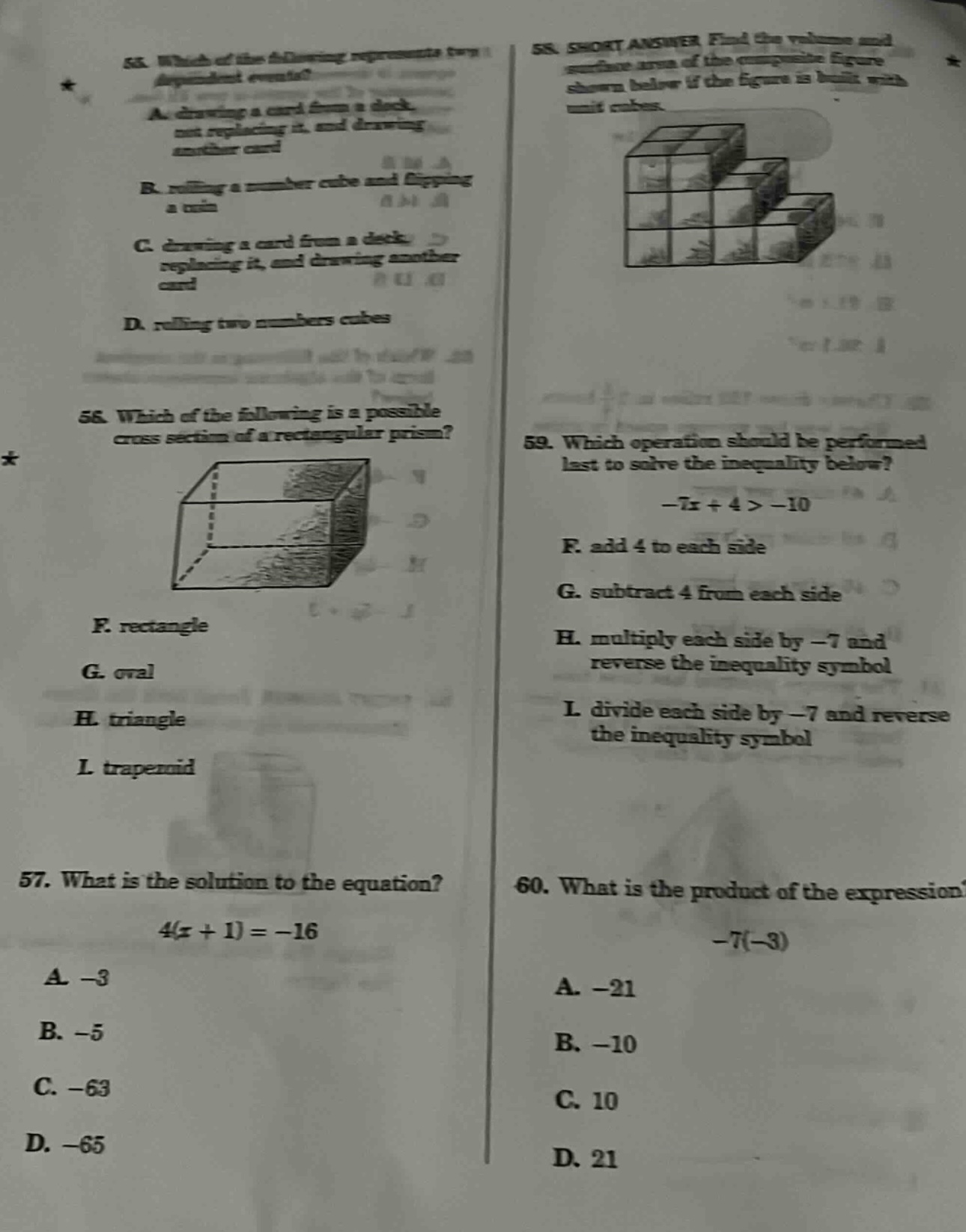
55. which of the following represents two dependent events? a. drawing a card from a deck, not replacing it, and drawing another card b. rolling a number cube and flipping a coin c. drawing a card from a deck, replacing it, and drawing another card d. rolling two numbers cubes 56. which of the following is a possible cross - section of a rectangular prism? f. rectangle g. oval h. triangle i. trapezoid 57. what is the solution to the equation? 4(x + 1)=-16 a. -3 b. -5 c. -63 d. -65 58. short answer find the volume and surface area of the composite figure shown below if the figure is built with unit cubes. 59. which operation should be performed last to solve the inequality below? -7x + 4 > -10 f. add 4 to each side g. subtract 4 from each side h. multiply each side by -7 and reverse the inequality symbol i. divide each side by -7 and reverse the inequality symbol 60. what is the product of the expression -7(-3) a. -21 b. -10 c. 10 d. 21
Answer
55.
Explanation:
Step1: Define dependent events
Dependent events are those where the outcome of the first - event affects the outcome of the second event.
Step2: Analyze each option
- Option A: Drawing a card from a deck without replacement changes the composition of the deck for the second draw, so the two draws are dependent events.
- Option B: Rolling a number cube and flipping a coin are independent since the result of rolling the cube has no impact on the coin - flip and vice - versa.
- Option C: Drawing a card from a deck with replacement means the deck is in its original state for the second draw, so the two draws are independent.
- Option D: Rolling two number cubes are independent as the result of the first roll does not affect the second roll.
Answer:
A. drawing a card from a deck, not replacing it, and drawing another card
56.
Explanation:
A rectangular prism can have a cross - section that is a rectangle when cut parallel to one of its faces, a triangle when cut diagonally through three non - parallel faces, and a trapezoid when cut at an angle through four non - parallel faces. But an oval cannot be a cross - section of a rectangular prism.
Answer:
F. rectangle, H. triangle, I. trapezoid
57.
Explanation:
Step1: Expand the left - hand side
Using the distributive property (a(b + c)=ab+ac), we have (4(x + 1)=4x+4). So the equation becomes (4x + 4=-16).
Step2: Isolate the variable term
Subtract 4 from both sides: (4x+4 - 4=-16 - 4), which simplifies to (4x=-20).
Step3: Solve for x
Divide both sides by 4: (\frac{4x}{4}=\frac{-20}{4}), so (x = - 5).
Answer:
B. - 5
58. (No question text provided for 58 in the description, skipping)
59.
Explanation:
Step1: Start with the inequality (-7x + 4>-10)
First, we want to isolate the term with the variable. We subtract 4 from both sides: (-7x+4 - 4>-10 - 4), which gives (-7x>-14).
Step2: Solve for x
To get x alone, we divide both sides by - 7. When dividing an inequality by a negative number, we reverse the inequality symbol. So (\frac{-7x}{-7}<\frac{-14}{-7}).
Answer:
I. divide each side by - 7 and reverse the inequality symbol
60.
Explanation:
When we multiply two negative numbers, the result is positive. So (-7\times(-3)=21).
Answer:
D. 21