60. within a population of bacteria, some may have genes that give them resistance to antibiotics. if an…
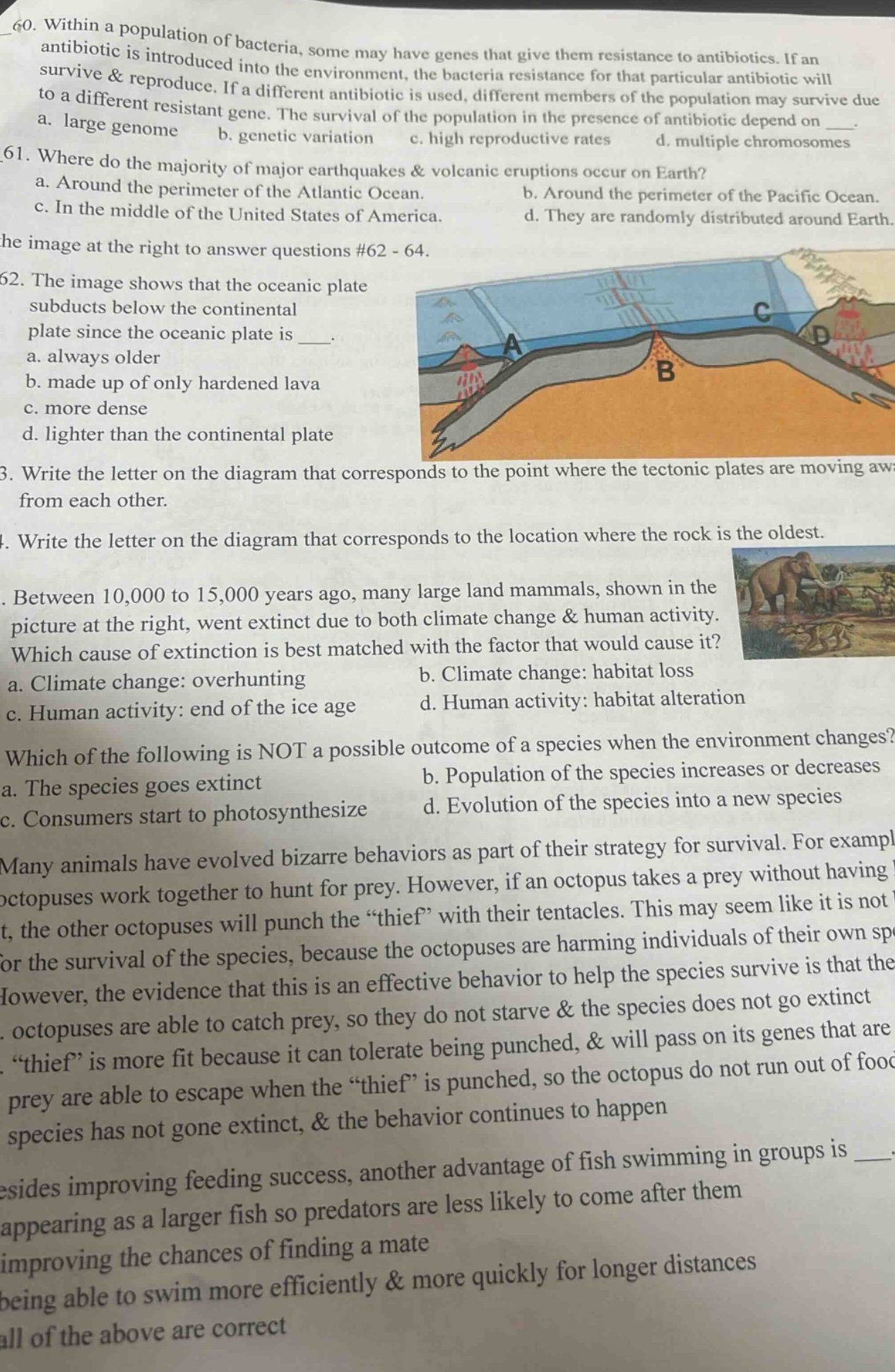
60. within a population of bacteria, some may have genes that give them resistance to antibiotics. if an antibiotic is introduced into the environment, the bacteria resistance for that particular antibiotic will survive & reproduce. if a different antibiotic is used, different members of the population may survive due to a different resistant gene. the survival of the population in the presence of antibiotic depend on ___.\na. large genome b. genetic variation c. high reproductive rates d. multiple chromosomes\n61. where do the majority of major earthquakes & volcanic eruptions occur on earth?\na. around the perimeter of the atlantic ocean.\nb. around the perimeter of the pacific ocean.\nc. in the middle of the united states of america.\nd. they are randomly distributed around earth.\nuse the image at the right to answer questions #62 - 64.\n62. the image shows that the oceanic plate subducts below the continental plate since the oceanic plate is ___.\na. always older\nb. made up of only hardened lava\nc. more dense\nd. lighter than the continental plate\n63. write the letter on the diagram that corresponds to the point where the tectonic plates are moving away from each other.\n64. write the letter on the diagram that corresponds to the location where the rock is the oldest.\nbetween 10,000 to 15,000 years ago, many large land mammals, shown in the picture at the right, went extinct due to both climate change & human activity. which cause of extinction is best matched with the factor that would cause it?\na. climate change: overhunting b. climate change: habitat loss\nc. human activity: end of the ice age d. human activity: habitat alteration\nwhich of the following is not a possible outcome of a species when the environment changes?\na. the species goes extinct b. population of the species increases or decreases\nc. consumers start to photosynthesize d. evolution of the species into a new species\nmany animals have evolved bizarre behaviors as part of their strategy for survival. for example, octopuses work together to hunt for prey. however, if an octopus takes a prey without having the right, the other octopuses will punch the “thief” with their tentacles. this may seem like it is not good for the survival of the species, because the octopuses are harming individuals of their own species. however, the evidence that this is an effective behavior to help the species survive is that the octopuses are able to catch prey, so they do not starve & the species does not go extinct. the “thief” is more fit because it can tolerate being punched, & will pass on its genes that are beneficial for survival. also, the prey are able to escape when the “thief” is punched, so the octopus do not run out of food. the species has not gone extinct, & the behavior continues to happen.\nbesides improving feeding success, another advantage of fish swimming in groups is ___.\na. appearing as a larger fish so predators are less likely to come after them\nb. improving the chances of finding a mate\nc. being able to swim more efficiently & more quickly for longer distances\nd. all of the above are correct
Answer
Brief Explanations:
- Question 60: Genetic variation allows different bacteria to have different resistance - related genes, enabling some to survive in the presence of antibiotics.
- Question 61: The "Ring of Fire" around the perimeter of the Pacific Ocean is known for having a high concentration of major earthquakes and volcanic eruptions due to tectonic plate activity.
- Question 62: Oceanic plates are denser than continental plates, which causes them to subduct below the continental plates.
- Question 63: At mid - ocean ridges (where tectonic plates move apart), new crust is formed. In the diagram, this is likely point B.
- Question 64: The oldest rocks are found furthest from the mid - ocean ridge. In the diagram, this is likely point D.
- Question 65: Climate change can cause habitat loss, and human activity can cause habitat alteration.
- Question 66: Consumers cannot start to photosynthesize as they lack the necessary structures and pigments for photosynthesis.
- Question 67: The fact that the species has not gone extinct and the behavior continues indicates that it is an effective survival behavior.
- Question 68: Fish swimming in groups have multiple advantages including appearing as a larger fish to deter predators, improving the chances of finding a mate, and swimming more efficiently.
Answer:
-
- b. genetic variation
-
- b. Around the perimeter of the Pacific Ocean.
-
- c. more dense
-
- B
-
- D
-
- d. Human activity: habitat alteration
-
- c. Consumers start to photosynthesize
-
- The species has not gone extinct, and the behavior continues to happen
-
- e. all of the above are correct