74. why does ice float in water? explain using density. 75. what is the difference between a physical change…
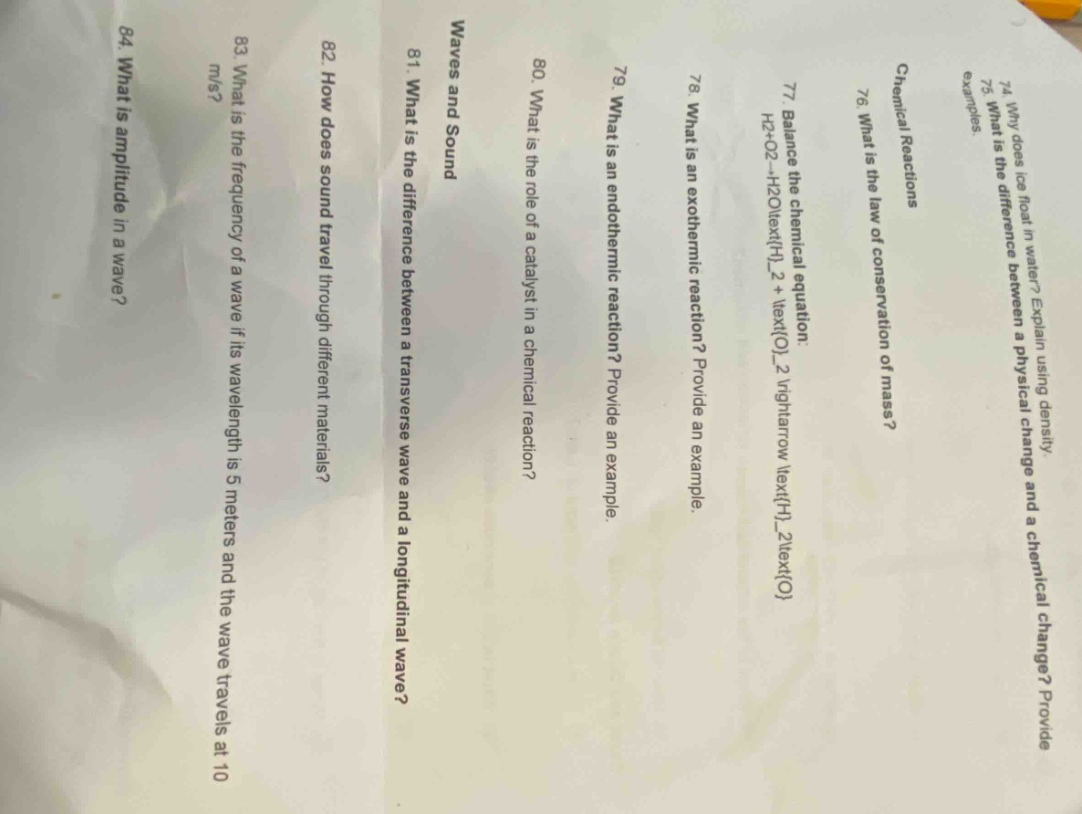
74. why does ice float in water? explain using density. 75. what is the difference between a physical change and a chemical change? provide examples. 76. what is the law of conservation of mass? 77. balance the chemical equation: h₂+o₂→h₂o (text{h}_2 + text{o}_2 rightarrow text{h}_2text{o}) 78. what is an exothermic reaction? provide an example. 79. what is an endothermic reaction? provide an example. 80. what is the role of a catalyst in a chemical reaction? 81. what is the difference between a transverse wave and a longitudinal wave? 82. how does sound travel through different materials? 83. what is the frequency of a wave if its wavelength is 5 meters and the wave travels at 10 m/s? 84. what is amplitude in a wave?
Answer
Brief Explanations:
- Ice floats in water because its density is less than that of water. A physical change is a change in the form or state of matter without changing its chemical composition (e.g., melting ice). A chemical change results in a new substance being formed (e.g., iron rusting).
- The law of conservation of mass states that in a closed - system chemical reaction, the total mass of the reactants equals the total mass of the products.
- The balanced chemical equation for $H_2 + O_2\rightarrow H_2O$ is $2H_2+O_2 = 2H_2O$.
- An exothermic reaction releases heat to the surroundings. Example: Combustion of wood.
- An endothermic reaction absorbs heat from the surroundings. Example: Dissolving ammonium nitrate in water.
- A catalyst in a chemical reaction increases the rate of the reaction without being consumed in the reaction itself.
- A transverse wave has particles vibrating perpendicular to the direction of wave propagation, while a longitudinal wave has particles vibrating parallel to the direction of wave propagation.
- Sound travels through different materials by the vibration of particles. It travels fastest through solids, slower through liquids, and slowest through gases.
- The frequency of a wave can be calculated using the formula $v = f\lambda$, where $v$ is the wave - speed, $f$ is the frequency, and $\lambda$ is the wavelength. Given $v = 10$ m/s and $\lambda=5$ m, then $f=\frac{v}{\lambda}=\frac{10}{5}=2$ Hz.
- Amplitude in a wave is the maximum displacement of the particles of the medium from their equilibrium position.
Answer:
- Ice floats because its density is less than water's. Physical change: change in form/state without new substance (e.g., melting ice). Chemical change: new substance formed (e.g., iron rusting).
- In a closed - system chemical reaction, total mass of reactants = total mass of products.
- $2H_2+O_2 = 2H_2O$
- Exothermic reaction: releases heat. Example: Combustion of wood.
- Endothermic reaction: absorbs heat. Example: Dissolving ammonium nitrate in water.
- Catalyst increases reaction rate without being consumed.
- Transverse wave: particles vibrate perpendicular to wave direction. Longitudinal wave: particles vibrate parallel to wave direction.
- Sound travels through particle vibration, fastest in solids, slower in liquids, slowest in gases.
- $f = 2$ Hz
- Amplitude is maximum displacement of medium particles from equilibrium position.