△abc is reflected about the line y = -x to give △abc with vertices a(-1, 1), b(-2, -1), c(-1, 0). what are…
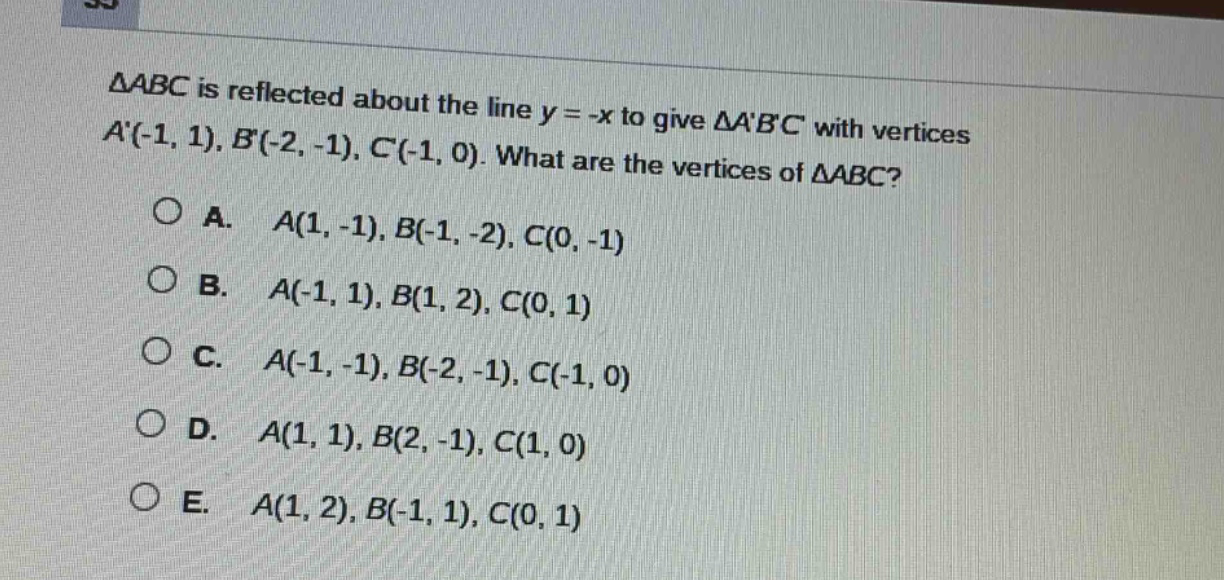
△abc is reflected about the line y = -x to give △abc with vertices a(-1, 1), b(-2, -1), c(-1, 0). what are the vertices of △abc?\n\na. a(1, -1), b(-1, -2), c(0, -1)\nb. a(-1, 1), b(1, 2), c(0, 1)\nc. a(-1, -1), b(-2, -1), c(-1, 0)\nd. a(1, 1), b(2, -1), c(1, 0)\ne. a(1, 2), b(-1, 1), c(0, 1)
Answer
Explanation:
Step1: Recall reflection rule
The rule for reflecting a point $(x,y)$ about the line $y = -x$ is $(x,y)\to(-y,-x)$. To find the original point from the reflected - point, we reverse the rule. If $(x',y')$ is the reflected point and $(x,y)$ is the original point, then $x=-y'$ and $y = -x'$.
Step2: Find coordinates of point A
For point $A'(-1,1)$, using $x=-y'$ and $y=-x'$, we have $x=-1$ and $y = 1$. So the coordinates of $A$ are $(1, - 1)$.
Step3: Find coordinates of point B
For point $B'(-2,-1)$, using $x=-y'$ and $y=-x'$, we get $x = 1$ and $y=-(-2)=2$. So the coordinates of $B$ are $(-1,-2)$.
Step4: Find coordinates of point C
For point $C'(-1,0)$, using $x=-y'$ and $y=-x'$, we have $x = 0$ and $y=-(-1)=1$. So the coordinates of $C$ are $(0,-1)$.
Answer:
A. $A(1, - 1),B(-1,-2),C(0,-1)$