according to the rational root theorem, which is a factor of the polynomial (f(x)=3x^{3}-5x^{2}-12x +…
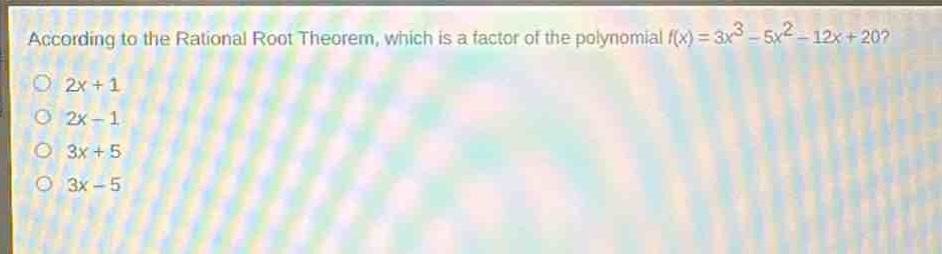
according to the rational root theorem, which is a factor of the polynomial (f(x)=3x^{3}-5x^{2}-12x + 20)?\n(2x + 1)\n(2x - 1)\n(3x + 5)\n(3x - 5)
Answer
Explanation:
Step1: Recall Rational Root Theorem
The Rational Root Theorem states that if a polynomial (a_nx^n + a_{n - 1}x^{n-1}+\cdots+a_1x + a_0) has a rational root (p/q), then (p) is a factor of the constant term (a_0) and (q) is a factor of the leading - coefficient (a_n). For the polynomial (f(x)=3x^3 - 5x^2-12x + 20), (a_n = 3) and (a_0=20). The possible rational roots are of the form (\pm\frac{p}{q}), where (p) is a factor of (20) (i.e., (p=\pm1,\pm2,\pm4,\pm5,\pm10,\pm20)) and (q) is a factor of (3) (i.e., (q = \pm1,\pm3)). So the possible rational roots are (\pm1,\pm2,\pm4,\pm5,\pm10,\pm20,\pm\frac{1}{3},\pm\frac{2}{3},\pm\frac{4}{3},\pm\frac{5}{3},\pm\frac{10}{3},\pm\frac{20}{3}).
Step2: Test each option for root
For a linear factor (ax + b), the root is (x=-\frac{b}{a}).
- For (2x + 1), (x=-\frac{1}{2}). Substitute (x =-\frac{1}{2}) into (f(x)): [ \begin{align*} f\left(-\frac{1}{2}\right)&=3\left(-\frac{1}{2}\right)^3-5\left(-\frac{1}{2}\right)^2-12\left(-\frac{1}{2}\right)+20\ &=3\times\left(-\frac{1}{8}\right)-5\times\frac{1}{4}+6 + 20\ &=-\frac{3}{8}-\frac{5}{4}+26\ &=-\frac{3 + 10}{8}+26\ &=-\frac{13}{8}+26\ &=\frac{-13 + 208}{8}=\frac{195}{8}\neq0 \end{align*} ]
- For (2x - 1), (x=\frac{1}{2}). Substitute (x=\frac{1}{2}) into (f(x)): [ \begin{align*} f\left(\frac{1}{2}\right)&=3\left(\frac{1}{2}\right)^3-5\left(\frac{1}{2}\right)^2-12\left(\frac{1}{2}\right)+20\ &=3\times\frac{1}{8}-5\times\frac{1}{4}-6 + 20\ &=\frac{3}{8}-\frac{5}{4}+14\ &=\frac{3 - 10}{8}+14\ &=-\frac{7}{8}+14\ &=\frac{-7+112}{8}=\frac{105}{8}\neq0 \end{align*} ]
- For (3x + 5), (x =-\frac{5}{3}). Substitute (x =-\frac{5}{3}) into (f(x)): [ \begin{align*} f\left(-\frac{5}{3}\right)&=3\left(-\frac{5}{3}\right)^3-5\left(-\frac{5}{3}\right)^2-12\left(-\frac{5}{3}\right)+20\ &=3\times\left(-\frac{125}{27}\right)-5\times\frac{25}{9}+20 + 20\ &=-\frac{125}{9}-\frac{125}{9}+40\ &=\frac{-125-125 + 360}{9}\ &=\frac{-250+360}{9}=\frac{110}{9}\neq0 \end{align*} ]
- For (3x - 5), (x=\frac{5}{3}). Substitute (x=\frac{5}{3}) into (f(x)): [ \begin{align*} f\left(\frac{5}{3}\right)&=3\left(\frac{5}{3}\right)^3-5\left(\frac{5}{3}\right)^2-12\left(\frac{5}{3}\right)+20\ &=3\times\frac{125}{27}-5\times\frac{25}{9}-20 + 20\ &=\frac{125}{9}-\frac{125}{9}\ &=0 \end{align*} ] Since (x = \frac{5}{3}) is a root of (f(x)), then ((3x - 5)) is a factor of (f(x)) by the Factor Theorem (if (f(c)=0), then ((x - c)) is a factor of (f(x)), and for (x=\frac{5}{3}), (3x-5 = 3\left(x-\frac{5}{3}\right))).
Answer:
D. (3x - 5)