according to the rational root theorem, the following are potential roots of $f(x)=6x^{4}+5x^{3}-33x^{2}-12x…
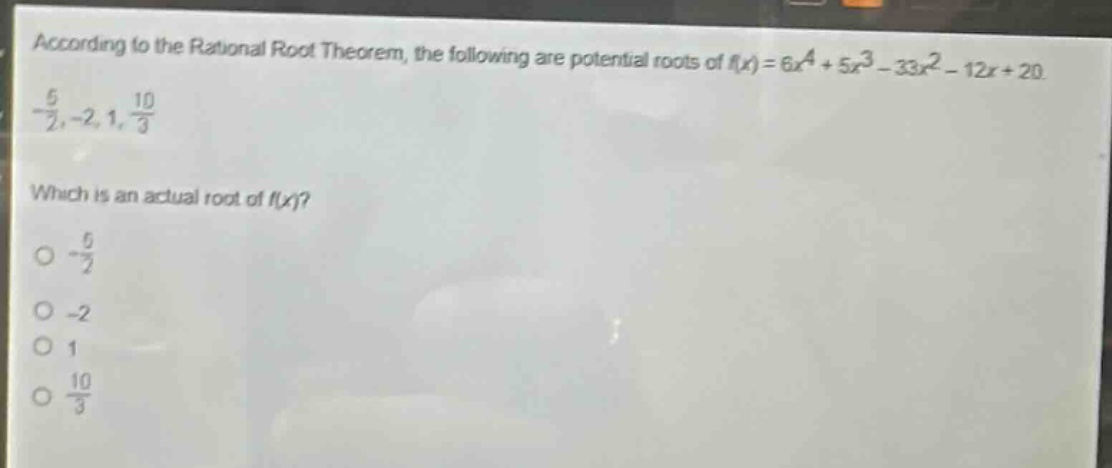
according to the rational root theorem, the following are potential roots of $f(x)=6x^{4}+5x^{3}-33x^{2}-12x + 20$.\n$-\frac{5}{2},-2,1,\frac{10}{3}$\nwhich is an actual root of $f(x)$?\n$-\frac{5}{2}$\n$-2$\n$1$\n$\frac{10}{3}$
Answer
Explanation:
Step1: Substitute $x = -\frac{5}{2}$ into $f(x)$
$f(-\frac{5}{2})=6(-\frac{5}{2})^{4}+5(-\frac{5}{2})^{3}-33(-\frac{5}{2})^{2}-12(-\frac{5}{2}) + 20$ $=6\times\frac{625}{16}+5\times(-\frac{125}{8})-33\times\frac{25}{4}+30 + 20$ $=\frac{1875}{8}-\frac{625}{8}-\frac{825}{4}+50$ $=\frac{1875 - 625}{8}-\frac{825}{4}+50$ $=\frac{1250}{8}-\frac{825}{4}+50$ $=\frac{625}{4}-\frac{825}{4}+50$ $=-\frac{200}{4}+50$ $=- 50+50=0$
Step2: Check other values for confirmation
For $x=-2$: $f(-2)=6(-2)^{4}+5(-2)^{3}-33(-2)^{2}-12(-2)+20$ $=6\times16+5\times(-8)-33\times4 + 24+20$ $=96-40 - 132+24+20$ $=(96 + 24+20)-(40 + 132)$ $=140 - 172=-32\neq0$
For $x = 1$: $f(1)=6\times1^{4}+5\times1^{3}-33\times1^{2}-12\times1+20$ $=6 + 5-33-12+20$ $=(6 + 5+20)-(33 + 12)$ $=31 - 45=-14\neq0$
For $x=\frac{10}{3}$: $f(\frac{10}{3})=6(\frac{10}{3})^{4}+5(\frac{10}{3})^{3}-33(\frac{10}{3})^{2}-12(\frac{10}{3})+20$ $=6\times\frac{10000}{81}+5\times\frac{1000}{27}-33\times\frac{100}{9}-40 + 20$ $=\frac{20000}{27}+\frac{5000}{27}-\frac{1100}{3}-20$ $=\frac{20000 + 5000}{27}-\frac{9900}{27}-20$ $=\frac{25000-9900}{27}-20$ $=\frac{15100}{27}-20$ $=\frac{15100-540}{27}=\frac{14560}{27}\neq0$
Answer:
$-\frac{5}{2}$