according to the rational root theorem, which number is a potential root of $f(x)=9x^{8}+9x^{6}-12x +…
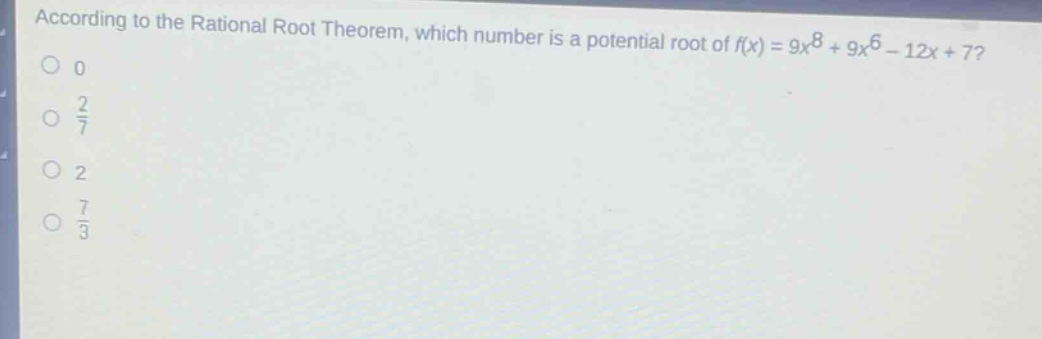
according to the rational root theorem, which number is a potential root of $f(x)=9x^{8}+9x^{6}-12x + 7$?\n0\n$\frac{2}{7}$\n2\n$\frac{7}{3}$
Answer
Explanation:
Step1: Recall Rational Root Theorem
The Rational Root Theorem states that if a polynomial (f(x)=a_nx^n + a_{n - 1}x^{n-1}+\cdots+a_1x + a_0) has integer - coefficients, then any rational root (p/q) of the polynomial must satisfy: (p) is a factor of the constant term (a_0) and (q) is a factor of the leading - coefficient (a_n). For the polynomial (f(x)=9x^8 + 9x^6-12x + 7), the leading coefficient (a_n = 9) and the constant term (a_0 = 7).
Step2: Find factors of (a_0) and (a_n)
The factors of (a_0 = 7) are (\pm1,\pm7), and the factors of (a_n = 9) are (\pm1,\pm3,\pm9). The possible rational roots (p/q) are of the form (\pm\frac{1}{1},\pm\frac{1}{3},\pm\frac{1}{9},\pm\frac{7}{1},\pm\frac{7}{3},\pm\frac{7}{9}).
Step3: Check each option
- Option 1: For (x = 0), since (0) is not of the form (\pm\frac{p}{q}) where (p) is a factor of (7) and (q) is a factor of (9), (0) is not a potential root.
- Option 2: For (x=\frac{2}{7}), since (2) is not a factor of (7), (\frac{2}{7}) is not a potential root.
- Option 3: For (x = 2), since (2) is not a factor of (7), (2) is not a potential root.
- Option 4: For (x=\frac{7}{3}), (p = 7) is a factor of the constant term (7) and (q = 3) is a factor of the leading - coefficient (9), so (\frac{7}{3}) is a potential root.
Answer:
D. (\frac{7}{3})