according to the rational roots theorem, which is a possible root at point p?\nthe root at point p may be…
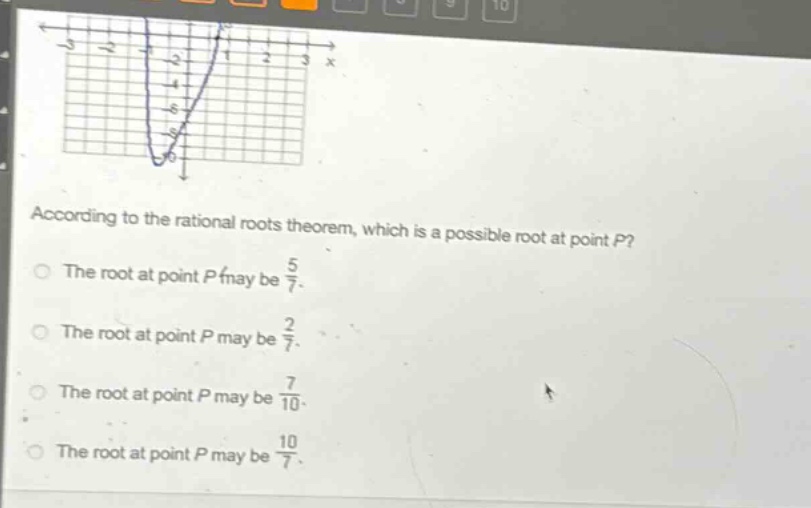
according to the rational roots theorem, which is a possible root at point p?\nthe root at point p may be $\frac{5}{7}$.\nthe root at point p may be $\frac{2}{7}$.\nthe root at point p may be $\frac{7}{10}$.\nthe root at point p may be $\frac{10}{7}$.
Answer
Explanation:
Step1: Recall rational - roots theorem
The rational - roots theorem states that if a polynomial equation (a_nx^n + a_{n - 1}x^{n - 1}+\cdots+a_1x + a_0=0) has integer coefficients (a_n,a_{n - 1},\cdots,a_1,a_0), then any rational root (p/q) of the equation must have (p) as a factor of the constant term (a_0) and (q) as a factor of the leading - coefficient (a_n). In the context of finding the root of a polynomial from its graph, we assume the polynomial has integer coefficients. For a rational number (p/q) to be a root, (p) is a factor of the constant term and (q) is a factor of the leading coefficient. Usually, we consider the simplest non - reducible form.
Step2: Analyze the options
We need to check which of the given fractions is in the form of a possible rational root. A rational root of a polynomial with integer coefficients is of the form (\frac{p}{q}), where (p) is an integer factor of the constant term and (q) is an integer factor of the leading coefficient. Without knowing the polynomial, we can still note that for a rational root (\frac{p}{q}), (p) and (q) are relatively prime (in lowest terms). Among the options (\frac{5}{7}), (\frac{2}{7}), (\frac{7}{10}), and (\frac{10}{7}), we know that if the polynomial has integer coefficients, a rational root is of the form (\frac{\text{factor of constant}}{\text{factor of leading coefficient}}). If we assume the polynomial has integer coefficients, a rational root (x = \frac{p}{q}) where (p) and (q) are relatively prime. The denominator (q) should be a factor of the leading coefficient and the numerator (p) should be a factor of the constant term. Let's assume the polynomial is a non - zero polynomial with integer coefficients. A rational root of the polynomial is of the form (\frac{p}{q}) in lowest terms. The rational roots theorem implies that the possible rational roots are of the form (\frac{\text{factor of the constant term}}{\text{factor of the leading coefficient}}). If we assume the leading coefficient and the constant term are non - zero integers, we know that for a rational root (\frac{p}{q}), (p) and (q) are integers and (\gcd(p,q)=1). The possible rational root should be in the form where the numerator and denominator are relatively prime. Among the given options, if we consider the general form of the rational roots theorem, a possible rational root is of the form (\frac{p}{q}). We know that a rational root of a polynomial (a_nx^n+\cdots + a_0) with integer coefficients has (p) (numerator) as a factor of (a_0) and (q) (denominator) as a factor of (a_n). The answer is based on the fact that the rational roots of a polynomial with integer coefficients are of the form (\frac{p}{q}) where (p) is a factor of the constant term and (q) is a factor of the leading coefficient.
Answer:
The root at point (P) may be (\frac{10}{7}).