an acute triangle has side lengths 21 cm, x cm, and 2x cm. if 21 is one of the shorter sides of the…
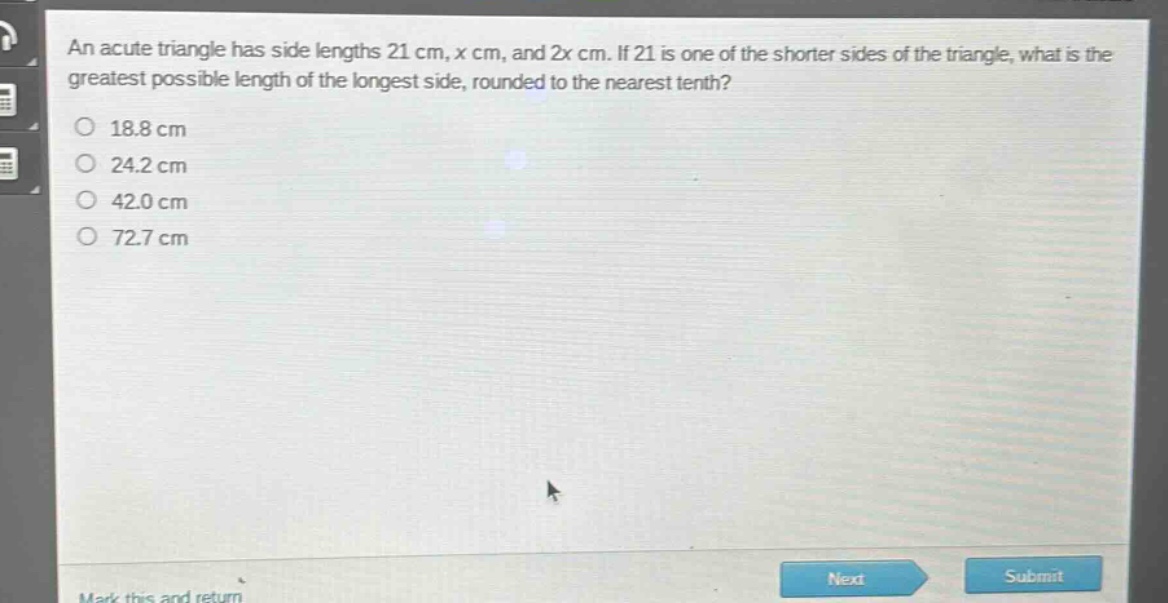
an acute triangle has side lengths 21 cm, x cm, and 2x cm. if 21 is one of the shorter sides of the triangle, what is the greatest possible length of the longest side, rounded to the nearest tenth?\n18.8 cm\n24.2 cm\n42.0 cm\n72.7 cm
Answer
Explanation:
Step1: Apply the acute - triangle inequality
For an acute triangle with side lengths (a), (b), and (c) ((c) being the longest side), (a^{2}+b^{2}>c^{2}). Here, since 21 is one of the shorter sides and the sides are 21, (x), and (2x) ((2x) is the longest side), we have (21^{2}+x^{2}>(2x)^{2}). [21^{2}+x^{2}>4x^{2}] [441 + x^{2}>4x^{2}] [441>3x^{2}] [x^{2}<147] [x < \sqrt{147}\approx12.124] Also, considering the triangle - inequality theorem: (a + b>c), so (21 + x>2x), which gives (x<21). The more restrictive condition is (x < \sqrt{147}).
Step2: Find the length of the longest side
The longest side is (2x). Substituting the maximum value of (x\approx12.124) into (2x), we get (2x\approx2\times12.124 = 24.248\approx24.2) cm.
Answer:
24.2 cm