adiya said that the first step to solving the quadratic equation $x^{2}+6 = 20x$ by completing the square…
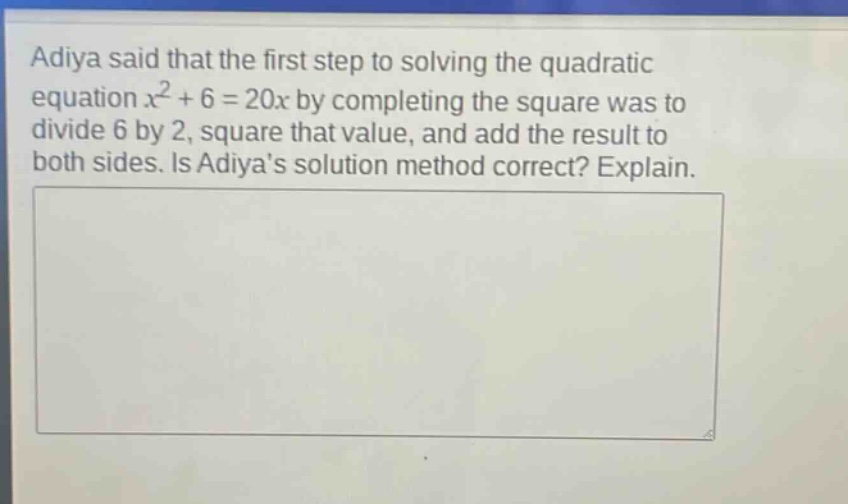
adiya said that the first step to solving the quadratic equation $x^{2}+6 = 20x$ by completing the square was to divide 6 by 2, square that value, and add the result to both sides. is adiyas solution method correct? explain.
Answer
Explanation:
Step1: Recall completing - the - square method
For a quadratic equation of the form $ax^{2}+bx + c = 0$ ($a\neq0$), we first make the coefficient of $x^{2}$ equal to 1 (if it isn't already) and then work with the linear - term coefficient. The general form for completing the square for $x^{2}+bx + c = 0$ is $(x+\frac{b}{2})^{2}= - c+\left(\frac{b}{2}\right)^{2}$. For the equation $x^{2}+6 = 20x$, we rewrite it in standard form $x^{2}-20x+6 = 0$.
Step2: Identify the correct coefficient to use
In the standard - form quadratic equation $x^{2}-20x + 6=0$, the coefficient of the $x$ - term is $-20$, not 6. When completing the square for $x^{2}-20x+6 = 0$, we should take half of the coefficient of the $x$ - term. So we take $\frac{-20}{2}=-10$, square it ($(-10)^{2}=100$), and add it to both sides of the equation, not $\frac{6}{2}$.
Answer:
No, Adiya's solution method is not correct. The correct first step for the equation $x^{2}-20x + 6=0$ is to take half of the coefficient of the $x$ - term ($-20$), square it, and add the result to both sides, not half of the constant term 6.