(b) adjust the figure on the right to explore the different triangles that can be formed. then answer the…
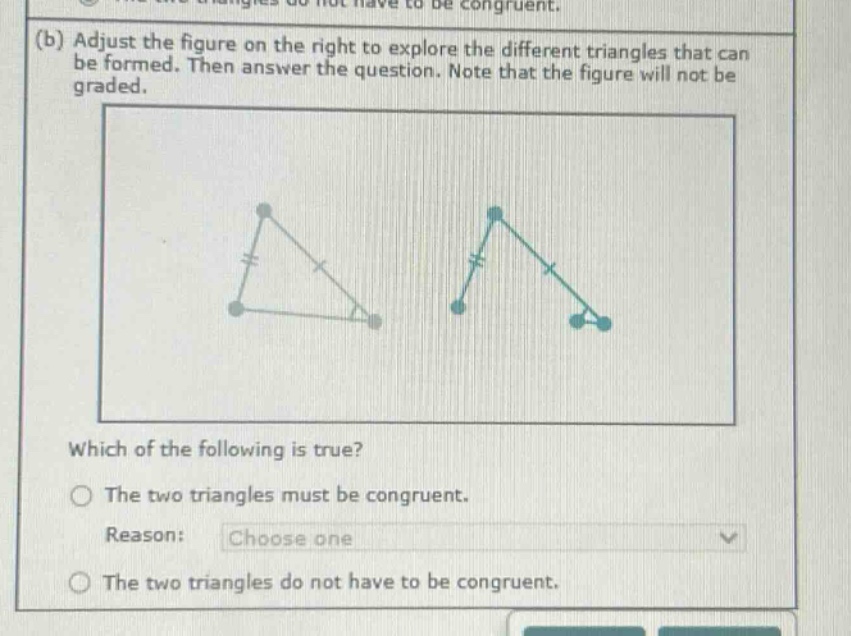
(b) adjust the figure on the right to explore the different triangles that can be formed. then answer the question. note that the figure will not be graded. which of the following is true? the two triangles must be congruent. reason: choose one the two triangles do not have to be congruent.
Answer
Explanation:
Step1: Analyze triangle - congruence conditions
To determine if two triangles are congruent, we need to check if they satisfy one of the congruence criteria such as SSS (Side - Side - Side), SAS (Side - Angle - Side), ASA (Angle - Side - Angle), AAS (Angle - Angle - Side), or HL (Hypotenuse - Leg for right - triangles). Here, we are only told to adjust the figure on the right to explore different triangles, and no information about equal sides or angles that would guarantee congruence is given.
Step2: Make a conclusion
Since there are no specific congruence - determining conditions met, the two triangles do not have to be congruent.
Answer:
The two triangles do not have to be congruent.