aisha is trying to determine if △lmn and △pqr are similar, congruent, or neither using the information in…
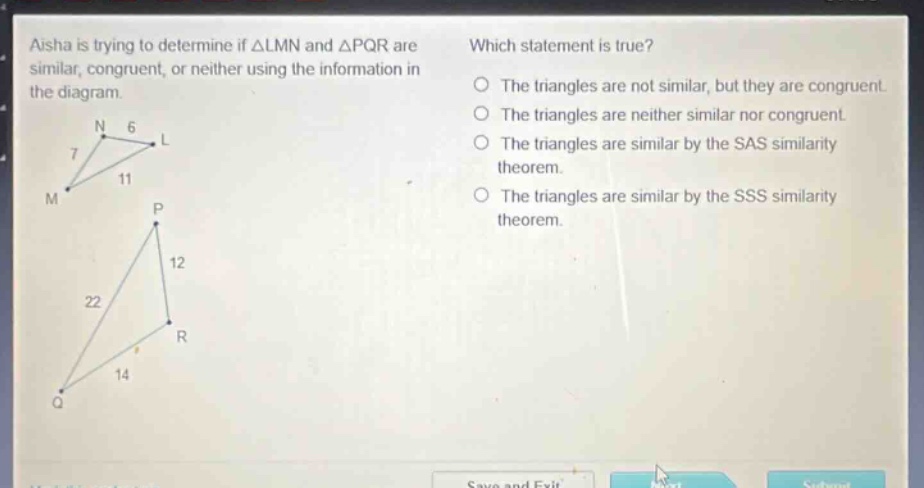
aisha is trying to determine if △lmn and △pqr are similar, congruent, or neither using the information in the diagram. which statement is true? the triangles are not similar, but they are congruent. the triangles are neither similar nor congruent. the triangles are similar by the sas similarity theorem. the triangles are similar by the sss similarity theorem.
Answer
Answer:
The triangles are similar by the SSS similarity theorem.
Explanation:
Step1: Find side - length ratios
For (\triangle LMN) with side lengths (LM = 11), (MN=7), (NL = 6) and (\triangle PQR) with side lengths (PQ = 22), (QR = 14), (RP=12). We calculate the ratios: (\frac{PQ}{LM}=\frac{22}{11} = 2), (\frac{QR}{MN}=\frac{14}{7}=2), (\frac{RP}{NL}=\frac{12}{6}=2).
Step2: Apply SSS similarity theorem
Since (\frac{PQ}{LM}=\frac{QR}{MN}=\frac{RP}{NL}=2), by the SSS (Side - Side - Side) similarity theorem, (\triangle LMN\sim\triangle PQR). The triangles are not congruent because the side - lengths are in proportion but not equal.