alan rewrites a fraction less than 1 as a decimal. the numerator is a whole number greater than 0. for which…
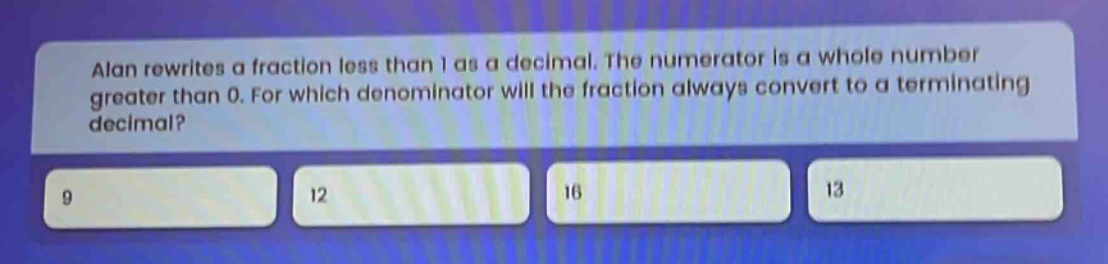
alan rewrites a fraction less than 1 as a decimal. the numerator is a whole number greater than 0. for which denominator will the fraction always convert to a terminating decimal? 9 12 16 13
Answer
Explanation:
Step1: Recall the rule for terminating decimals
A fraction $\frac{a}{b}$ (where $a$ is an integer and $b$ is a non - zero integer) converts to a terminating decimal if the denominator $b$ can be written in the form of $2^m\times5^n$, where $m$ and $n$ are non - negative integers.
Step2: Analyze the prime factorizations
- For $b = 9=3^2$, since it has a prime factor of 3 other than 2 and 5, it will not always give a terminating decimal.
- For $b = 12 = 2^2\times3$, since it has a prime factor of 3 other than 2 and 5, it will not always give a terminating decimal.
- For $b = 16=2^4$, it is in the form of $2^m\times5^n$ (here $m = 4$ and $n = 0$), so any fraction with denominator 16 will always convert to a terminating decimal.
- For $b = 13$, since 13 is a prime number other than 2 and 5, it will not always give a terminating decimal.
Answer:
16