which algebraic expressions are polynomials? check all that apply.\n$2x^{3}-\frac{1}{x}$\n$x^{3}y…
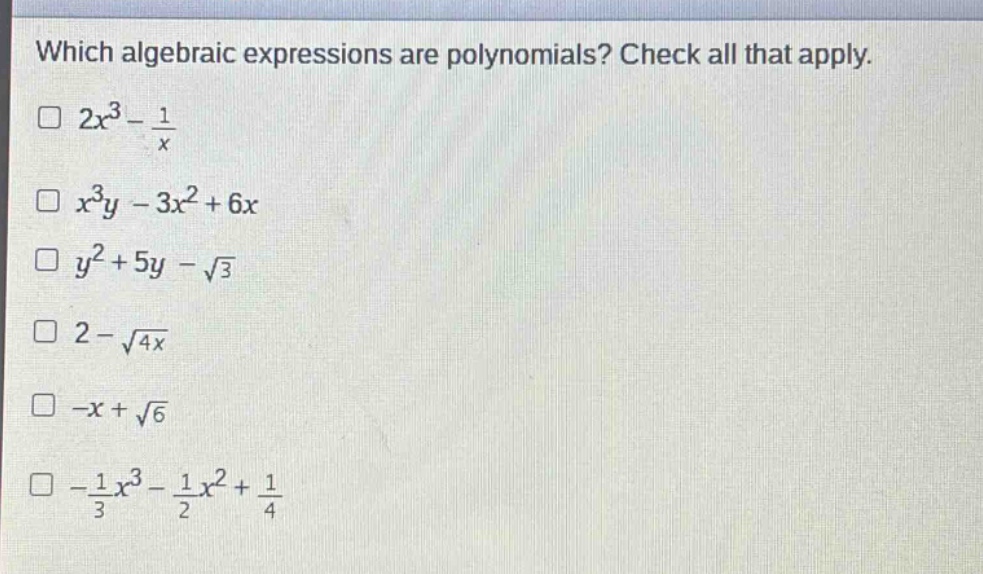
which algebraic expressions are polynomials? check all that apply.\n$2x^{3}-\frac{1}{x}$\n$x^{3}y - 3x^{2}+6x$\n$y^{2}+5y-sqrt{3}$\n$2-sqrt{4x}$\n$-x+sqrt{6}$\n$-\frac{1}{3}x^{3}-\frac{1}{2}x^{2}+\frac{1}{4}$
Answer
Explanation:
Step1: Recall polynomial definition
A polynomial in one or more variables consists of terms where the exponents of the variables are non - negative integers and there are no variables in the denominator or under a radical in a non - constant way.
Step2: Analyze $2x^{3}-\frac{1}{x}$
The term $\frac{1}{x}=x^{- 1}$, has a negative exponent. So it is not a polynomial.
Step3: Analyze $x^{3}y - 3x^{2}+6x$
The exponents of $x$ and $y$ ($3 + 1$ for the first term, $2$ for the second term, and $1$ for the third term) are non - negative integers. So it is a polynomial.
Step4: Analyze $y^{2}+5y-\sqrt{3}$
The exponents of $y$ ($2$ and $1$) are non - negative integers and $\sqrt{3}$ is a constant. So it is a polynomial.
Step5: Analyze $2-\sqrt{4x}$
The variable $x$ is under a square - root. So it is not a polynomial.
Step6: Analyze $-x+\sqrt{6}$
The exponent of $x$ is $1$ and $\sqrt{6}$ is a constant. So it is a polynomial.
Step7: Analyze $-\frac{1}{3}x^{3}-\frac{1}{2}x^{2}+\frac{1}{4}$
The exponents of $x$ ($3$, $2$) are non - negative integers and the coefficients are rational numbers. So it is a polynomial.
Answer:
$x^{3}y - 3x^{2}+6x$, $y^{2}+5y-\sqrt{3}$, $-x+\sqrt{6}$, $-\frac{1}{3}x^{3}-\frac{1}{2}x^{2}+\frac{1}{4}$